
── Resources
Resources for fishers, clubs and scientific communicators
Guides, posters and tools for understanding sanctuary science and caring for the places we fish.
Club learning pack
The sanctuary guide, research tools, a worked example, a 30-minute discussion, worksheet, glossaries and fishing Code in one download.
Other resources
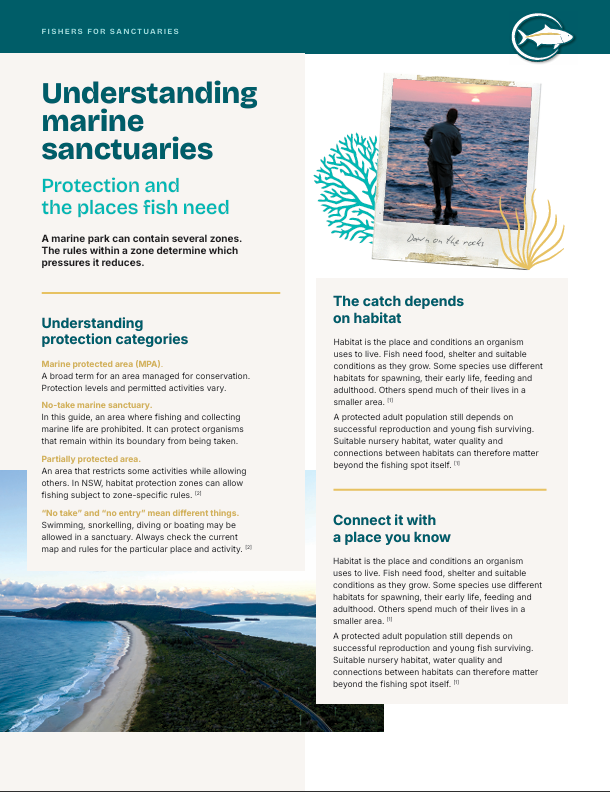
Marine sancurary guide
What protection can change, why results vary and what it means for fishing.
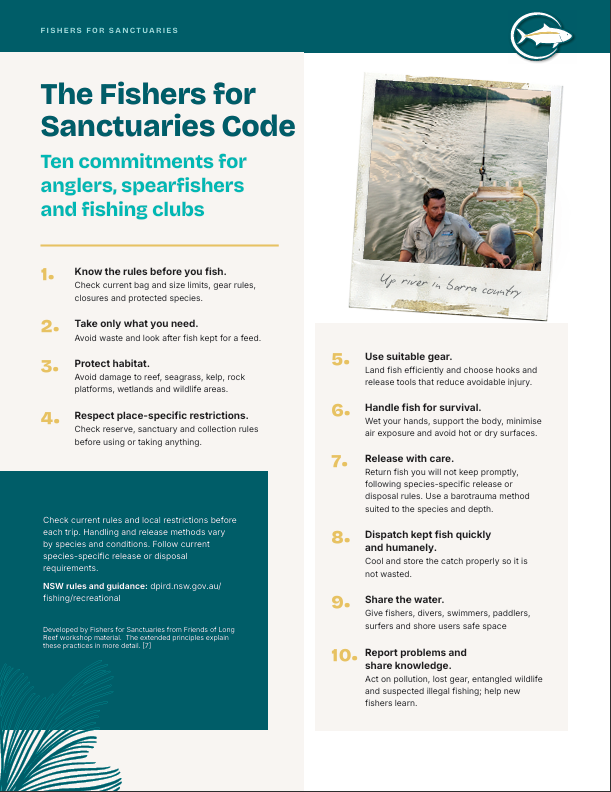
The code
Ten practical commitments for habitat, fish care and sharing the water.
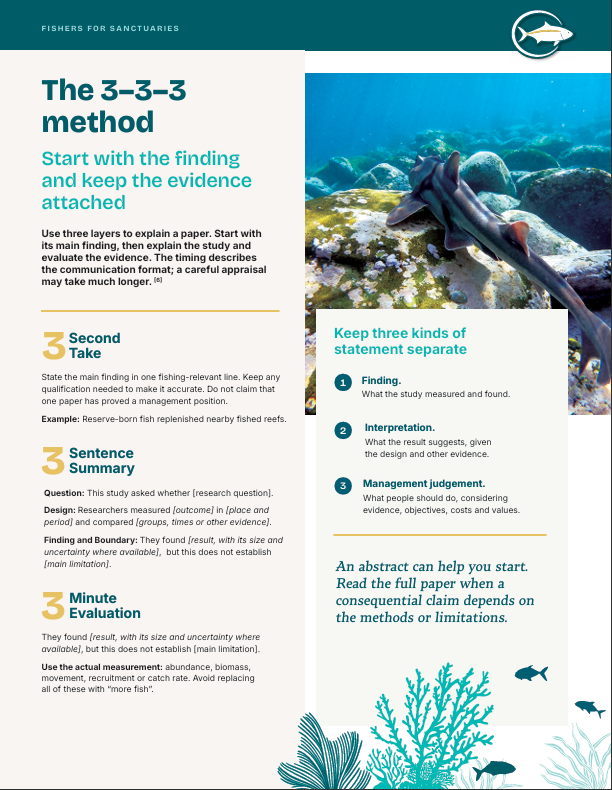
The 3-3-3 method
Summarise a study, assess its evidence and run a club discussion.
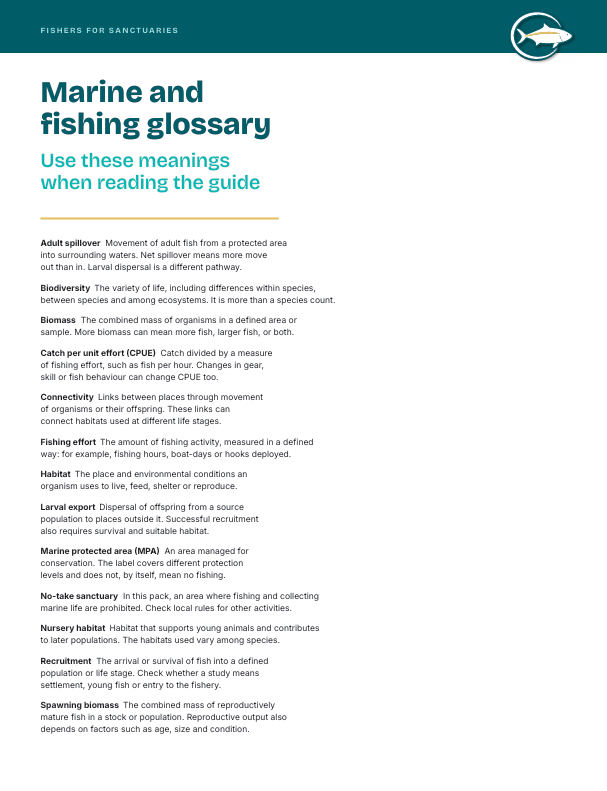
Marine research glossary
Definitions of the fisheries, marine science and research terms used in the pack.
RESILIENCE ON THE WATER Protecting NSW’s Recreational Fisheries
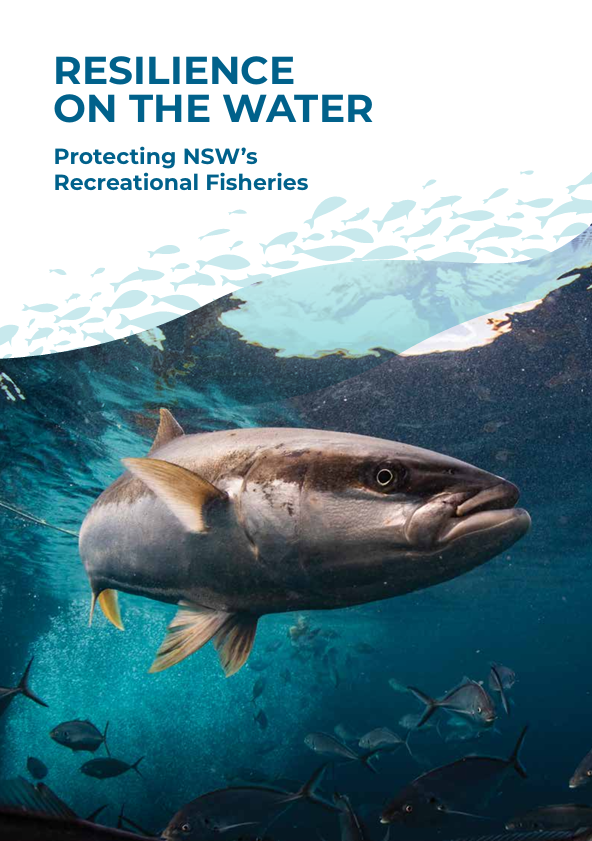
Written by Dr Alexander Rigg and Patrick Williams and published by the Australian Marine Conservation Society in 2025, this report examines how climate change and local environmental pressures are reshaping recreational fisheries in NSW.
Drawing on existing scientific research, it explains how warming oceans, marine heatwaves and habitat loss affect fish behaviour, spawning, recruitment and distribution. It considers the pressures facing familiar species, including snapper, kingfish, mulloway, whiting, flathead and luderick, and the habitats they depend on throughout their lives.
The report argues that sustaining recreational fishing requires protecting and restoring critical habitats, improving monitoring and using well-designed marine sanctuaries to support fish populations. It also highlights the contribution recreational fishers can make through observations, voluntary catch reporting and partnerships with scientists and managers.
| Term | Meaning |
|---|---|
| Anoxia | The absence of dissolved oxygen in water or sediment. |
| Barotrauma | Tissue injury caused by a change in pressure. In fish brought rapidly to the surface, expanding gases can damage the swim bladder and other tissues. |
| Benthic | Associated with the bottom of a body of water, including organisms living on the seafloor or within its sediment. |
| Biodiversity | The variety of life, including genetic variation within species, differences among species, and the diversity of ecosystems. |
| Climate change | Long-term changes in the average climate and its variability, usually over decades or longer. Current global warming is driven mainly by human greenhouse gas emissions. |
| Climate change hotspot | A region experiencing particularly rapid climatic change or strong impacts. In marine warming studies, this often refers to waters warming faster than the global ocean average. |
| Competition | An interaction in which organisms reduce one another’s access to a limited resource, such as food, space or shelter. It can occur within or between species. |
| Connectivity | The extent to which habitats or populations are linked by the movement of organisms, including larvae, juveniles and adults. These movements can contribute to population replenishment and gene flow. |
| Coral bleaching | The paling or whitening of corals when stress causes them to lose symbiotic algae or algal pigments. Bleached corals are still alive, but prolonged stress can cause death. |
| Corallivores | Animals that feed on coral, often by consuming coral tissue. Some also remove parts of the coral skeleton. |
| Demersal | Living on or close to the seafloor. Commonly used for fish that feed or spend much of their time near the bottom. |
| Dispersal | Movement away from a birthplace or previous habitat to another location. In marine systems, eggs, larvae, juveniles and adults can disperse. |
| Ecosystems | Communities of organisms and their physical environment, interacting through processes such as feeding, nutrient cycling and energy flow. |
| Ectotherms | Animals that obtain most of their body heat from their surroundings. Many can influence their temperature through behaviour, such as moving between warmer and cooler water. |
| Estuarine | Relating to estuaries, where freshwater from rivers or creeks meets seawater. Salinity commonly varies with tides, rainfall and river flow. |
| Food web | The network of feeding relationships in an ecosystem, showing who eats whom and how energy and nutrients pass between organisms. |
| Fragmentation | The breaking up of a continuous habitat into smaller, separated patches. This can affect movement between patches and the ecological processes they support. |
| Harmful algal bloom (HAB) | An increase or accumulation of algae or cyanobacteria that harms organisms or ecosystems, for example through toxins, oxygen depletion or damage to gills. |
| Hypoxia | Dissolved oxygen levels low enough to stress organisms or restrict their survival and activity. The relevant threshold depends on the species and conditions. |
| Marine heatwave (MHW) | A period of unusually warm seawater for a location and time of year. A widely used definition requires temperatures above the local, seasonally varying 90th percentile for at least five consecutive days, relative to a specified historical baseline. |
| Marine protected areas (MPAs) | Geographically defined marine or coastal areas designated and managed for long-term conservation of nature. Protection levels and permitted activities vary between areas and zones. |
| Metabolism | All the chemical reactions that sustain life, including those that release energy and build or break down molecules. |
| Paper parks | Protected areas that exist in law but lack sufficient management, resources or enforcement to achieve their conservation objectives. See Mora et al. (2006). |
| Parasite | An organism that lives in or on a host and obtains resources from it at the host’s expense. |
| Pathogen | A biological agent that causes disease, such as a virus, bacterium, fungus or parasite. |
| Pelagic fish | Fish that mainly occupy the water column rather than the seafloor. They can occur in coastal waters as well as offshore. |
| Pelagic larval phase / duration (PLD) | The pelagic larval phase is the stage larvae spend in the water column before settling into juvenile habitat. Pelagic larval duration (PLD) is the length of this phase. |
| Phase shift | A substantial, persistent change in ecosystem composition or structure, such as a kelp forest becoming an urchin barren. A phase shift does not, by itself, demonstrate the existence of alternative stable states. |
| Photosynthesis | The use of light energy to build organic molecules from carbon dioxide. Plants, algae and cyanobacteria release oxygen during this process; some other photosynthetic bacteria do not. |
| Plankton bloom | A rapid increase in plankton abundance, most commonly referring to phytoplankton. It may result from population growth, physical concentration, or both. |
| Plankton pulse | A brief increase in the abundance or availability of plankton at a place. The term emphasises the timing and short duration of the increase. |
| Predation | An interaction in which one organism, the predator, kills and eats another, the prey. |
| Recruitment | The addition of individuals to a defined population or life stage. In fisheries, it often means becoming vulnerable to fishing gear; in ecological studies, it may refer to settlement or survival beyond settlement. |
| Spillover effect | The net movement of juvenile or adult fish and other mobile animals from a protected area into surrounding waters. It may benefit nearby fisheries, but higher catches are not guaranteed. Larval export is a related, distinct process. |
| Tropicalisation | An increase in the occurrence, abundance or ecological influence of tropical species in temperate ecosystems, often associated with ocean warming. |
Sources for selected definitions
- Biodiversity and ecosystems: Convention on Biological Diversity, Article 2.
- Climate terminology: IPCC Sixth Assessment Report glossary.
- Coral bleaching: Australian Institute of Marine Science.
- Harmful algal blooms: NOAA: Are all algal blooms harmful?
- Marine heatwaves: Marine Heatwaves International Working Group, including the Hobday et al. (2016) definition.
- Marine protected areas: IUCN guidance on marine protected areas (PDF).
- Paper parks: Mora et al. (2006), Coral reefs and the global network of Marine Protected Areas.
- Phase shifts: Dudgeon et al. (2010), Phase shifts and stable states on coral reefs.
- Recruitment: Status of Australian Fish Stocks glossary.
- Spillover: Di Lorenzo et al. (2020), Assessing spillover from marine protected areas and its drivers.
Definitions reviewed .