
── Why Sanctuaries Matter
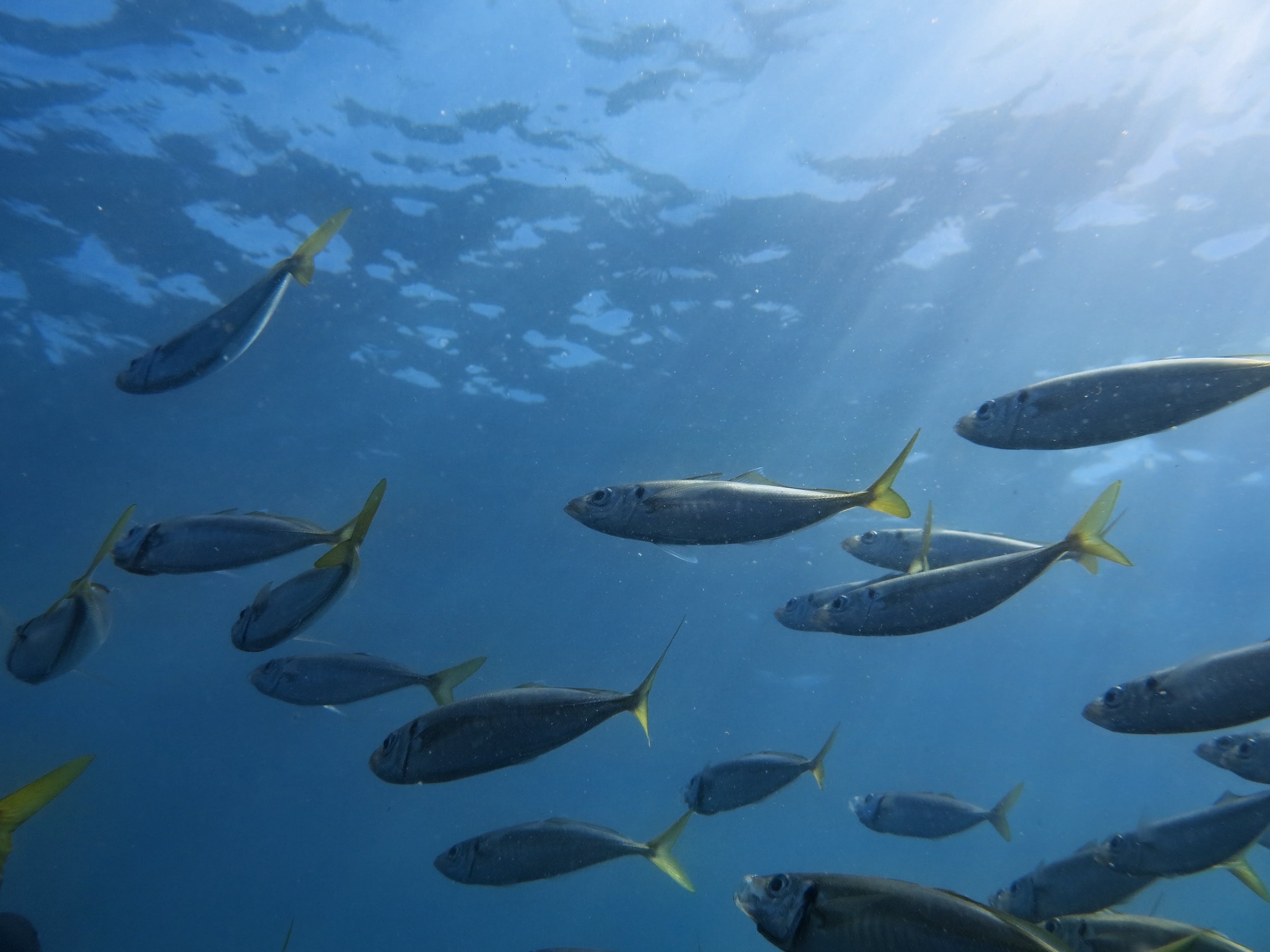
Marine sanctuaries give fish and other marine life places to grow and reproduce without fishing or collecting. They protect biodiversity and can help replenish fish populations in non-protected areas.
Explore the evidence
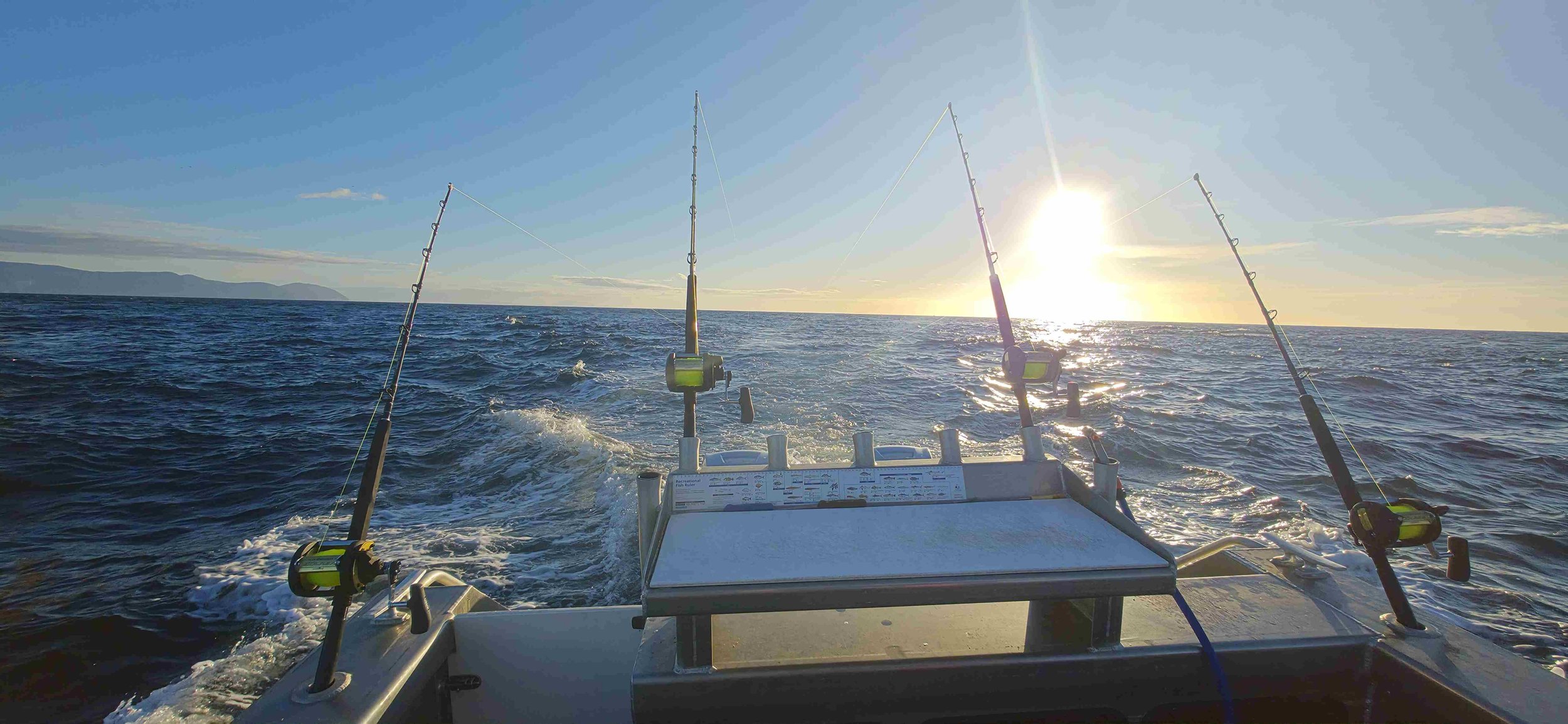
Research, Untangled explains the studies behind sanctuary protection, including how they were done, what they found and where the results apply. Read the summaries, examine their limitations and follow the links to the original research.
What is a marine sanctuary
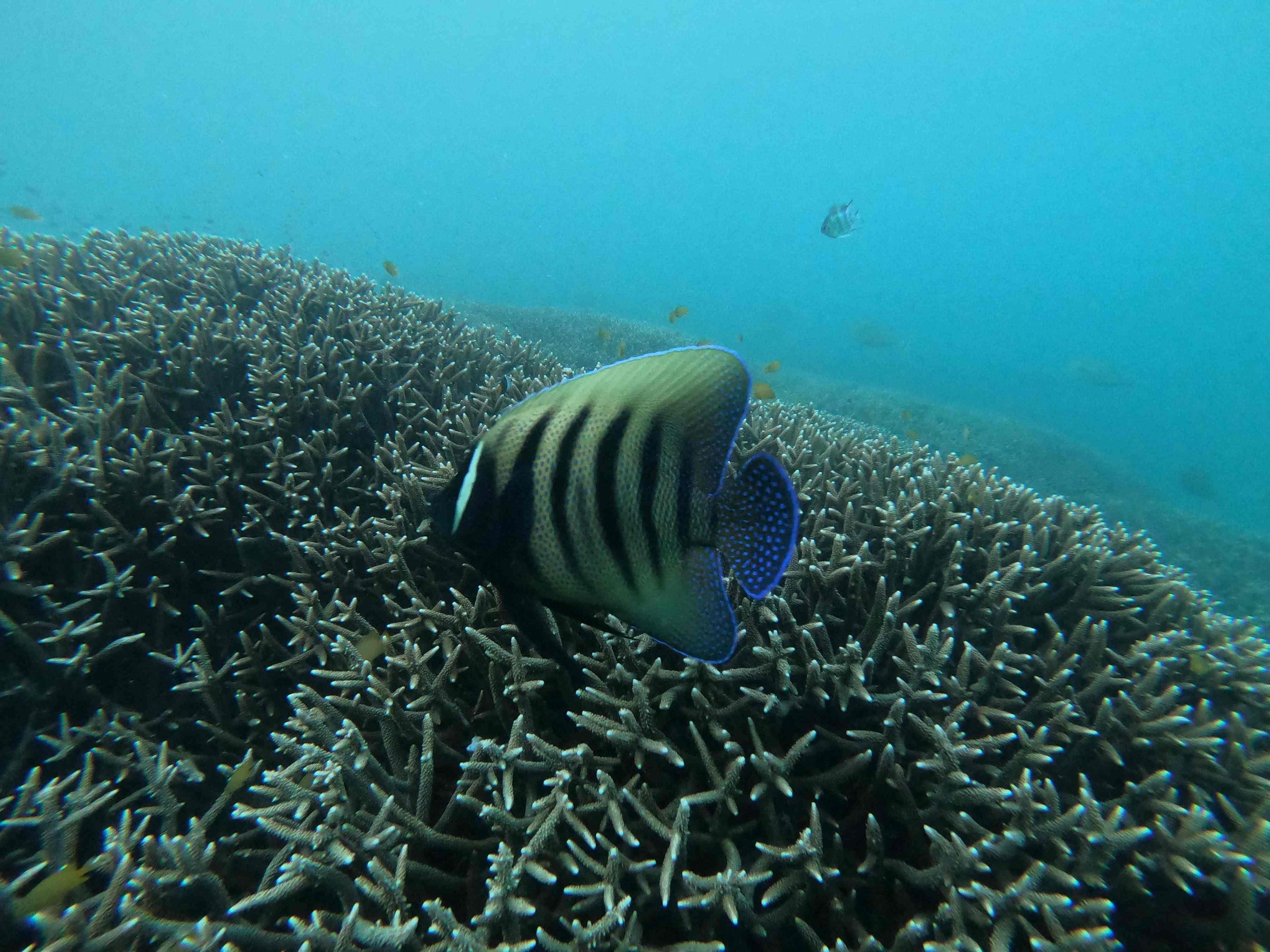
On this page, sanctuary means a no-take area, where fishing and collecting marine life are prohibited. A marine park can contain sanctuary zones alongside areas where fishing is allowed. Activities such as swimming, snorkeling and diving can continue where local rules permit.
Protecting the wider community
Predators, prey, grazers and habitat-forming organisms such as kelp are connected through food webs. Protecting marine life from fishing can change these relationships over time, with effects extending to species that people do not catch.
For us, conserving this wider community is a reason to support sanctuaries in its own right. Fishing benefits are valuable, but higher catches are not the only measure of conservation success.
How protection helps

Protection within the boundary
When no-take rules are followed, marine life is protected from capture and collection. Excluding fishing methods that damage the seabed also removes that source of habitat disturbance. Other local threats still need attention.

More fish surviving to breed
With fewer fish removed, more can survive to breed repeatedly and reach older ages and larger sizes. In many fish species, larger females make a particularly large contribution to reproduction. Protecting these fish helps maintain breeding populations.
Fish and offspring reaching surrounding waters
Some adult fish move beyond sanctuary boundaries. Eggs and larvae can also disperse to other habitats. These are different pathways: adult movement redistributes existing fish, while successful larval recruitment adds young fish to a population. Neither automatically means higher catches.

Understanding environmental change
Monitoring comparable protected and fished areas over time helps researchers assess the effects of fishing. These reference areas also help us understand wider environmental change. They remain exposed to pressures such as pollution and warming.
What makes sanctuaries effective
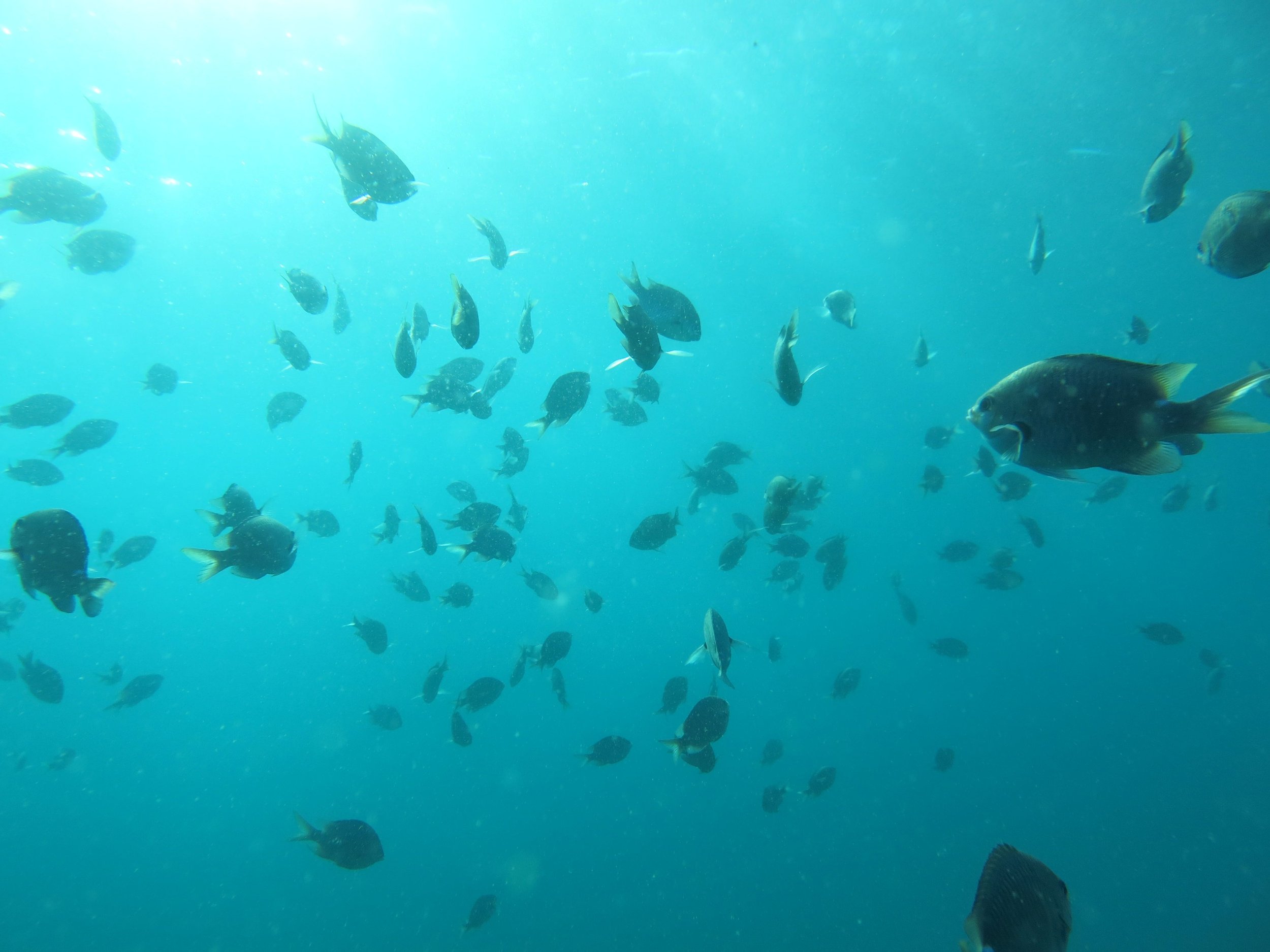
Effective sanctuaries need suitable design and sustained management. Individual areas must protect the species and ecological processes they are intended to conserve. A network must also cover the diversity of habitats across a region.
NEOLI and protection within a sanctuary
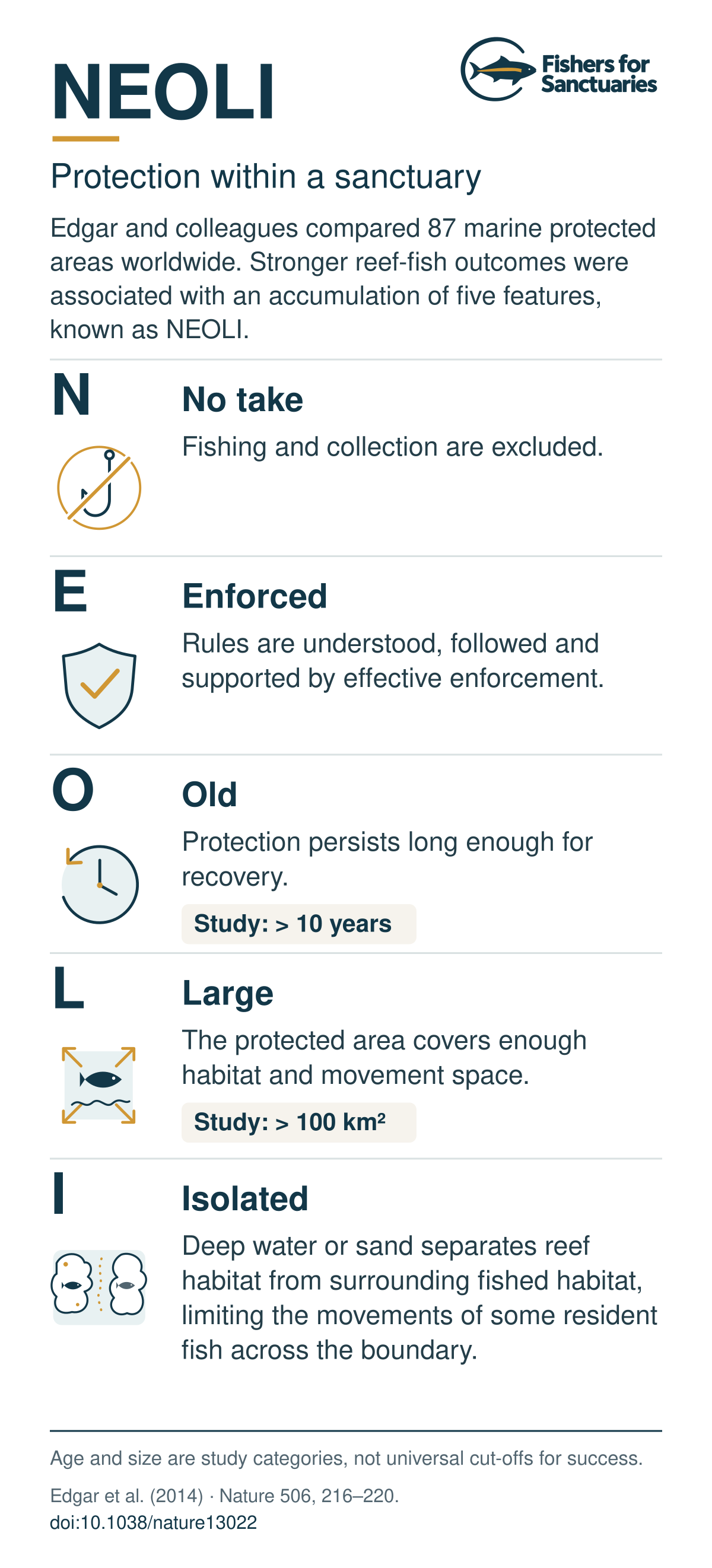
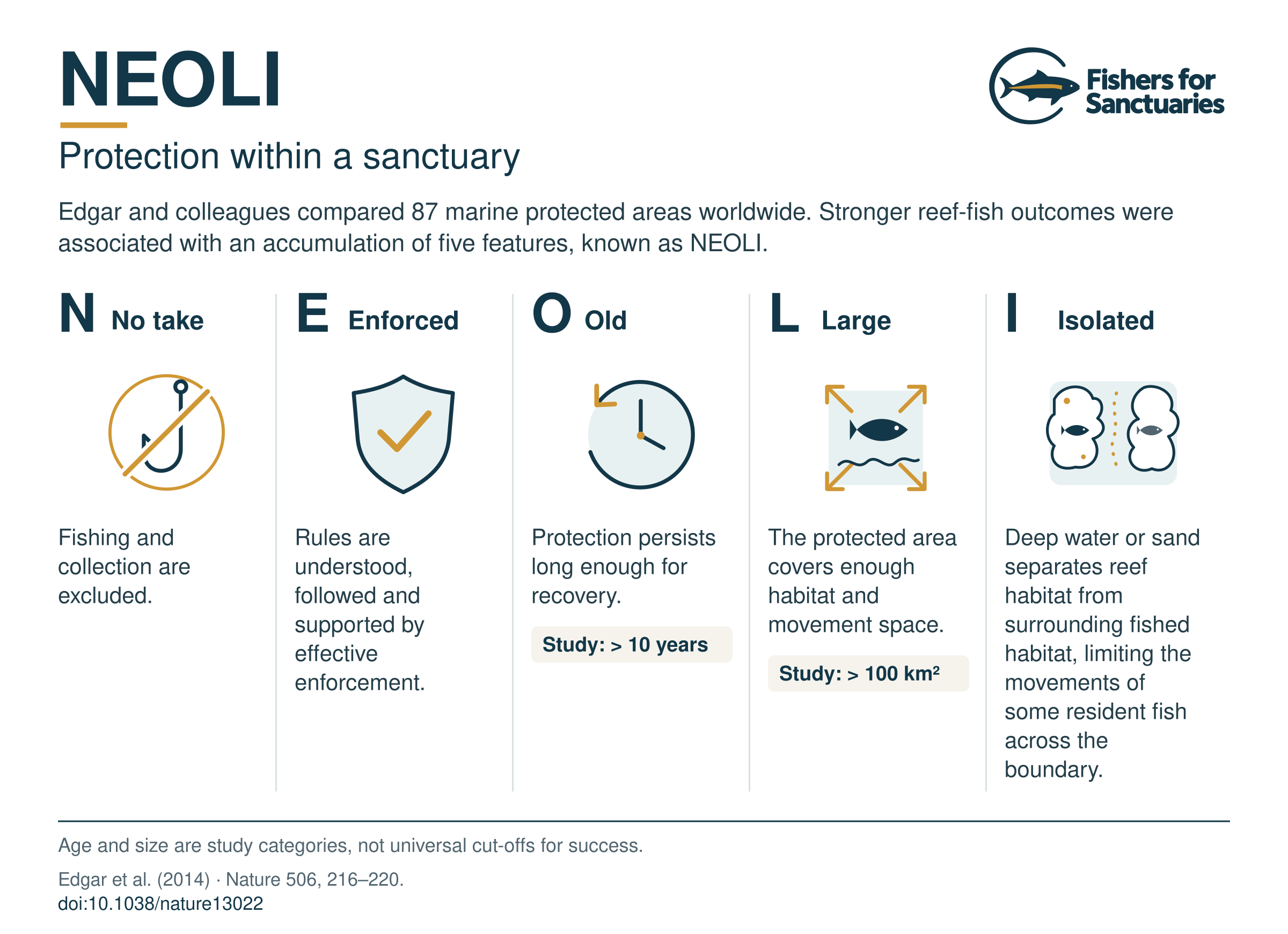
Edgar and colleagues compared 87 marine protected areas worldwide. Stronger reef-fish outcomes were associated with an accumulation of five features, known as NEOLI.
N — No take. Fishing and collection are excluded.
E — Enforced. Rules are understood, followed and supported by effective enforcement.
O — Old. Protection persists long enough for recovery. The study used more than 10 years.
L — Large. The protected area covers enough habitat and movement space. The study used more than 100 km².
I — Isolated. Deep water or sand separates reef habitat from surrounding fished habitat, limiting the movements of some resident fish across the boundary.
These study categories are not minimum requirements for every sanctuary. Small reserves can protect resident species, while wide-ranging species need protection at larger scales. Ecological isolation for adults can coexist with larval exchange between reefs; it does not mean cutting off a network from replenishment.
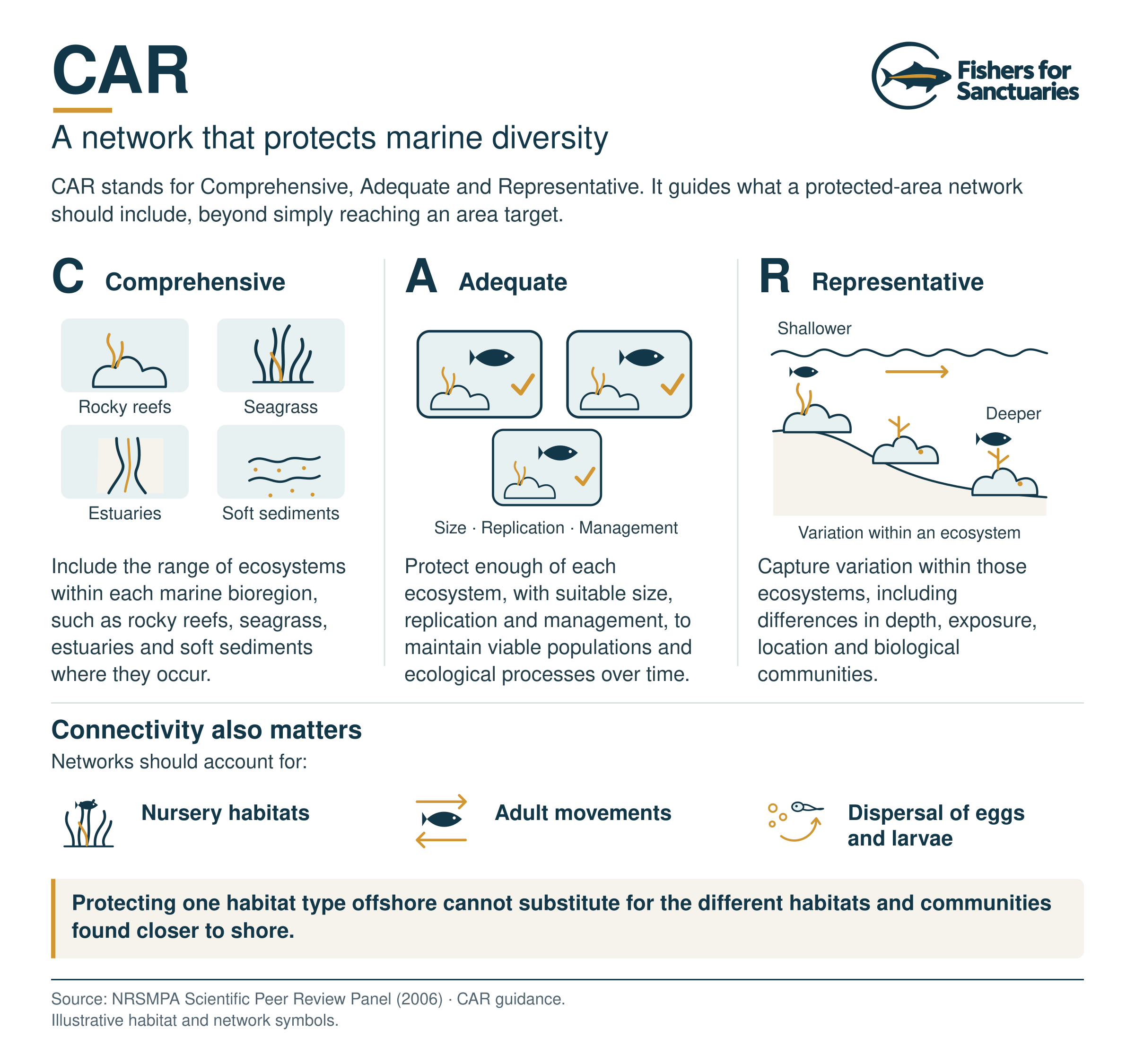
CAR and a network that protects marine diversity
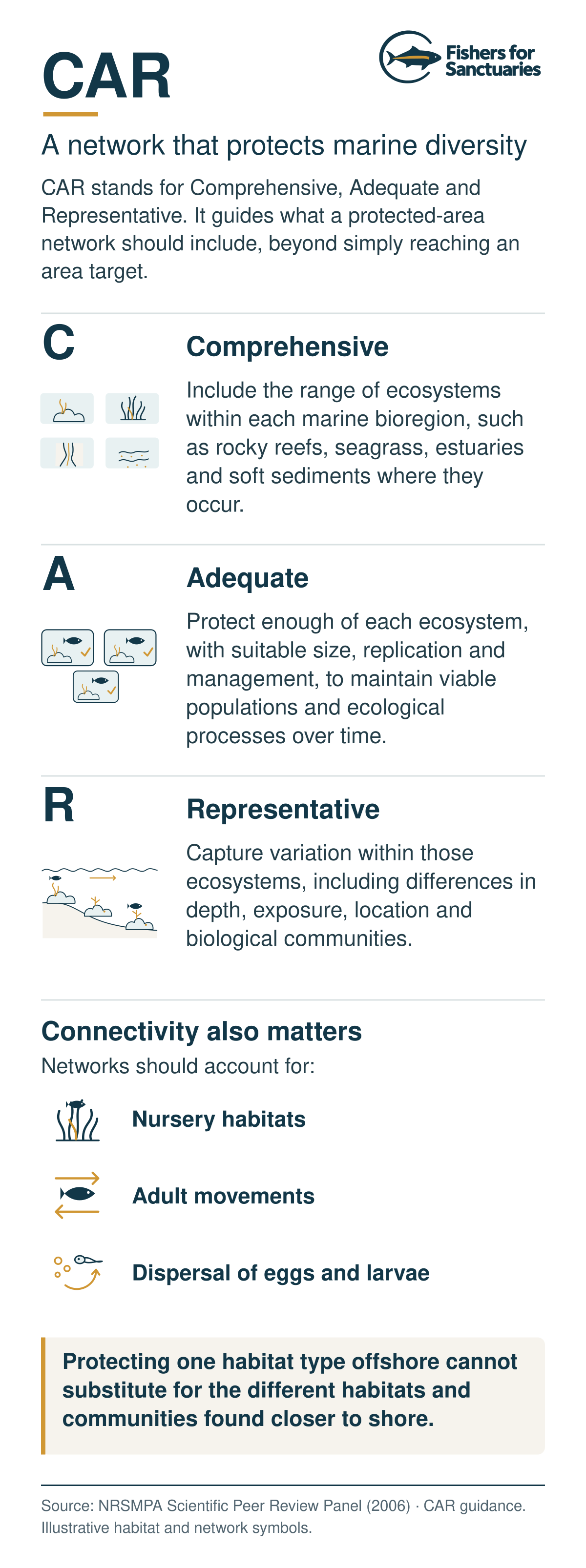
CAR stands for Comprehensive, Adequate and Representative. It guides what a protected-area network should include, beyond simply reaching an area target.
Comprehensive. Include the range of ecosystems within each marine bioregion, such as rocky reefs, seagrass, estuaries and soft sediments where they occur.
Adequate. Protect enough of each ecosystem, with suitable size, replication and management, to maintain viable populations and ecological processes over time.
Representative. Capture variation within those ecosystems, including differences in depth, exposure, location and biological communities.
Connectivity also matters. Networks should account for nursery habitats, adult movements and the dispersal of eggs and larvae. Protecting one habitat type offshore cannot substitute for the different habitats and communities found closer to shore.
Management and local knowledge
Staff, funding and monitoring are needed to turn boundaries into effective protection. Traditional Owners, fishers and local communities should help inform design and management. Assess changes in fishing access and displaced effort alongside ecological outcomes, then use monitoring to address shortcomings.
Our position
We support well-designed, effectively managed no-take sanctuaries that protect marine biodiversity, alongside responsible fishing and management of the surrounding waters. Their design should follow the evidence, consider local communities and be checked against clear conservation objectives.
Common questions
Habitat and fish life cycles
-
A sanctuary can prevent direct disturbance from the fishing methods and collection it excludes. Where bottom-contact fishing occurred, stopping it removes repeated disturbance to seabed organisms. Where it was already prohibited, a new sanctuary cannot claim that same additional benefit.
Protection can also change food webs as harvested predators and grazers recover. That may affect kelp, invertebrates and other habitat-forming organisms, but the direction and timing vary. No-take status alone does not repair every damaged habitat or control anchors, runoff and coastal development. Those pressures require specific management. Assess habitat condition directly, rather than assuming that more fish means habitat has recovered.
-
Demersal fish live on or near the seabed. Species that spend much of their lives within a protected area can receive sustained protection from fishing. More individuals may survive to reach larger sizes and older ages, increasing the breeding population.
Demersal does not mean immobile. Some snapper move widely, while other individuals remain associated with particular reefs. The amount of protection depends on habitat use and movement, as well as compliance. NSW monitoring found a strong snapper response in no-take areas, but much smaller changes across the other targeted fishes and little general response among non-target species. One species’ response should not be treated as the response of the whole community.
-
Many reef and seabed-associated fishes have larvae that develop in the water column before settling into juvenile habitat. The time spent in that stage is their pelagic larval duration, or PLD. Protected adults can contribute offspring to their own reef, another sanctuary or a fished area.
A longer PLD does not automatically mean greater dispersal or more recruitment. Currents, larval behaviour, development and survival influence where larvae go. Suitable settlement habitat and survival after settlement also matter. Protecting breeding adults is therefore only part of maintaining a connected population.
Genetic parentage studies on the Great Barrier Reef have identified juvenile coral trout and stripey snapper on fished reefs whose parents lived in reserves. This demonstrates larval export and recruitment. It does not establish that every sanctuary supplies nearby fishing grounds, or how many of those juveniles later enter catches.
-
Pelagic fish use the water column, and many range far beyond a small coastal sanctuary. Protection depends on how much time they spend inside it and whether it covers important feeding, breeding or aggregation areas. Movement also varies within a species: a fish may use one area repeatedly and later travel a long distance.
Studies of very large offshore protected areas have reported higher nearby catch rates for some tuna. That evidence cannot be transferred directly to a small NSW coastal sanctuary or to every pelagic species. Large reserves, seasonal protection and wider fisheries controls may be relevant at different scales. A sanctuary does not protect a migratory fish throughout its journey simply because it passes through once.
Protection and access
-
Partial protection can reduce particular pressures, such as damage from certain fishing gear, while retaining fishing access. Its value depends on exactly what is restricted. Fish that remain legal to catch still experience fishing mortality.
Comparative research generally finds stronger fish-biomass responses under no-take protection, especially for harvested species. However, a recent global analysis found that the difference narrowed after accounting for other factors, and well-managed multiple-use areas could perform strongly in some settings.
No-take protection provides areas free from fishing and collecting; partial protection can contribute to the surrounding network. The choice should follow the conservation objective and the pressures that need to be removed.
-
A no-take sanctuary does remove fishing access within its boundary. Losing a familiar spot can affect family traditions, safe access, travel costs and enjoyment. Those concerns deserve a meaningful place in decisions about sanctuary design.
The future of fishing also depends on protecting the marine life and habitats that make it possible. Keeping places open to fishing is only part of what we need to pass on to the next generation. We also need healthy seas, functioning food webs and places where marine life can grow and reproduce protected from harvest.
That is why we support well-designed sanctuaries. Their conservation purpose matters to everyone who values the ocean, including people who fish. Marine parks can combine sanctuary protection with zones that allow fishing, alongside opportunities for diving, boating and other activities.
Fishers should help shape these decisions, bringing local knowledge and identifying avoidable access costs. Supporting sanctuaries means accepting that protecting some places from fishing is a worthwhile investment in the future of the marine environment we depend on.
-
Bag and size limits regulate what fishers may take. Other fisheries controls regulate total harvest, methods or seasons. A no-take area protects a place and its marine life from fishing and collecting, including fish that could legally be retained elsewhere.
These tools operate differently. Harvest controls remain essential for fish that range beyond sanctuary boundaries and for fisheries as a whole. Sanctuaries can protect local populations and ecological relationships while providing reference areas for monitoring. An effective network needs management of the surrounding fishery; closing some areas cannot compensate for uncontrolled pressure across the rest.
-
Careful catch and release reduces mortality, but it does not eliminate it. Outcomes vary with species, hook injury, capture depth, handling and conditions. A fish swimming away is not proof that it survives.
Where the objective is a refuge from fishing, allowing repeated capture reintroduces a pressure the sanctuary is intended to remove. That is different from the role of catch and release in waters open to fishing, where good practice remains valuable. The rule reflects the area’s conservation objective.
-
Selective fishing can avoid some bycatch and seabed impacts associated with other methods. Fish retained by any method are still removed from the population. The ecological effect depends on the species, sizes taken, cumulative harvest and local fishing pressure.
A no-take area is intended to protect marine life from that removal. Allowing selected forms of harvest changes the protection provided and needs to be evaluated against the objective. This does not make responsible fishing elsewhere incompatible with conservation. It explains why a refuge from fishing uses a different rule from a place managed for sustainable harvest.
Fishing outcomes and the evidence
-
A fish does not need to remain inside for its entire life to receive some protection. What matters is how much fishing exposure is avoided, and whether important habitats or life stages are protected. Resident species can receive substantial protection; highly mobile species may receive much less from the same boundary.
Adult spillover means a net movement of fish from a protected area into surrounding waters. It can make fish available to fisheries, but it also exposes them to capture. Reserve shape, habitat continuity and fishing pressure outside affect that balance. Larval export is a separate pathway and can occur while the breeding adults remain within the sanctuary.
-
It can, but this is a separate question from whether fish recover inside. Benefits to fishing depend on adult movement or larval recruitment, survival outside, the time required and how fishing effort changes. Studies in some fisheries have documented benefits; others show weak or uncertain responses.
More biomass inside a sanctuary does not establish higher catches outside. Even increased catch rates near a boundary do not by themselves demonstrate a net increase in total fishery yield. For a recreational fisher, changes in travel, accessible grounds, catch size and catch rates all matter. We should measure those outcomes rather than promise that every lost fishing spot will be compensated.
-
It can displace effort into the areas that remain open. Depending on how people respond, that may increase crowding, travel or pressure on other habitats and fish populations. Some effort may instead reduce or move to a different fishery.
Planning should assess these possibilities before a closure, including effects on shore-based fishers and people with limited travel options. Monitoring should track where fishing effort goes and what happens to catches and habitats. Wider harvest controls and adjustments to management may be needed. Ecological gains inside a boundary should not be used to ignore costs or damage shifted outside it.
-
Those threats need direct action. Sanctuary boundaries cannot keep out warm water, sediment or contaminants, and no-take status does not by itself prevent damaging coastal development.
Reducing fishing pressure removes one source of mortality and can change how an ecosystem responds to other pressures. It does not guarantee resistance to heatwaves or habitat recovery. Protection should sit alongside catchment management, habitat restoration, action on emissions and sustainable fisheries. The presence of other threats does not make fishing effects irrelevant, but it does limit what a sanctuary can achieve on its own.
-
Yes. Habitat quality, depth, exposure, location and previous fishing pressure can differ between protected and fished sites. A simple comparison may confuse those differences with a protection effect.
More informative studies compare similar sites, use observations from before and after protection where available, repeat surveys through time and account for environmental differences. Statistical matching can improve comparisons, but it cannot remove every unmeasured difference. Evidence is stronger when several methods and places point to the same conclusion. A large percentage difference on its own is not enough to establish why it occurred.
-
Better fisheries management can rebuild depleted stocks and reduce ecological damage. We support it. But keeping catches sustainable does not, by itself, mean that the wider ecosystem is fully protected. Fish also have roles as predators, prey and breeding animals, and those roles extend beyond their value as a catch.
No-take sanctuaries add places where fishing and collecting are excluded. With effective protection and time, harvested populations can recover, and changes can extend through the food web. Long-term research shows that these wider ecological responses can take considerably longer than the initial response of target species.
Sanctuaries also provide reference areas that help us understand fishing’s effects and assess management elsewhere. Our position is that good management should combine effective fishing rules, habitat protection and a representative network of no-take sanctuaries. Each contributes something important to protecting marine life.
-
Take the result seriously. First ask whether the study measured the stated objective and had enough time, replication and precision to detect a meaningful change. Check compliance, fishing pressure before protection and whether boundaries match the species or habitats concerned.
Some effects take years or decades, particularly changes transmitted through food webs. Sometimes there is genuinely little improvement in the outcome measured. Managers should report that, investigate the explanation and reconsider design or management where warranted. Review should track ecological condition and effects on fishers, with explicit objectives and measures of success. More fish everywhere, or better fishing for everyone, is not a credible universal test.