
3 Second Summary
Well-enforced reserves held more target fish
Guidetti, P., Milazzo, M., Bussotti, S., Molinari, A., Murenu, M., Pais, A., Spanò, N., Balzano, R., Agardy, T., Boero, F., Carrada, G., Cattaneo-Vietti, R., Cau, A., Chemello, R., Greco, S., Manganaro, A., Notarbartolo di Sciara, G., Russo, G. F., & Tunesi, L. (2008). Italian marine reserve effectiveness: Does enforcement matter? Biological Conservation, 141(3), 699–709. https://doi.org/10.1016/j.biocon.2007.12.013
3 Sentence Summary
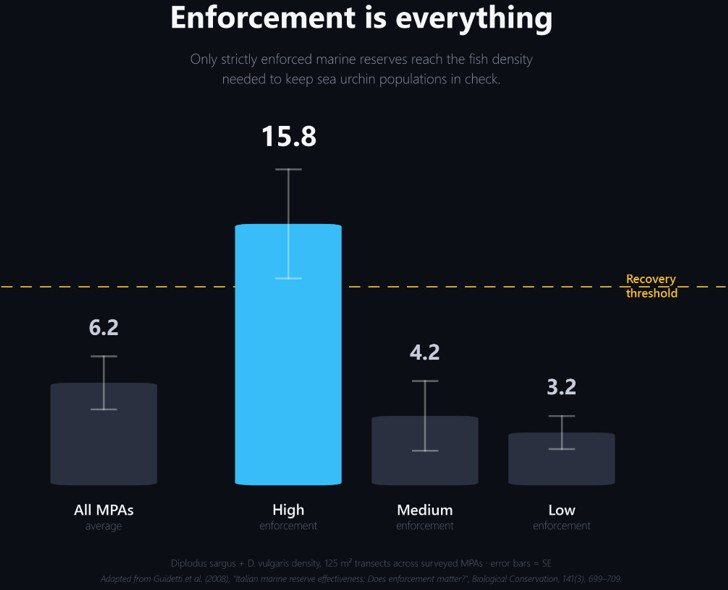
The researchers investigated whether enforcement determines how effective no-take marine reserves are. They conducted 3,096 underwater fish surveys across 15 Italian marine protected areas, comparing fish inside reserves with nearby fished reefs and grouping reserves by their level of enforcement. Well-enforced reserves supported around 2.4 times more targeted fish and 2.65 times greater biomass, while poorly enforced reserves were virtually indistinguishable from fished areas, showing that simply declaring a reserve is not enough.
3 Minute Evaluation
This was a large field study based on 3,096 underwater fish surveys across 15 Italian marine protected areas. Researchers compared fish density and estimated biomass inside no-take zones with nearby fished reefs.
Five research teams used the same survey methods, completed training before sampling, and repeated surveys across multiple sites and times. The results also included confidence intervals, helping show the level of uncertainty and increasing confidence in the findings.
The study does have some limitations. Only three reserves were classified as highly enforced, meaning this group had a relatively small sample size and wider uncertainty. Enforcement was also assessed using information from researchers, reserve managers and local communities rather than independent records of patrols, offences or illegal fishing, making it a practical but partly subjective measure.
Because this was an observational study, the researchers couldn't control all of the differences between reserves. Factors such as habitat type, reserve age, productivity and surrounding fishing pressure may also have influenced fish numbers. The study therefore demonstrates a strong relationship between enforcement and fish populations, but it cannot prove enforcement was the only cause.
There was also some uncertainty in the biomass estimates, as fish sizes were placed into broad visual categories rather than measured directly. The researchers focused on fish density and biomass and did not measure changes in sea urchins, algae or the wider reef ecosystem, so broader ecological conclusions rely partly on previous research.
The paper was published in 2008 in the peer-reviewed journal Biological Conservation by a large team of marine scientists from universities, government agencies and conservation organisations. Lead author Paolo Guidetti is a well-established researcher in marine protected areas.
Although the authors support marine reserves as a conservation tool, they also reported neutral findings from poorly enforced reserves rather than highlighting only successful examples, which strengthens the paper's credibility.
The study has since been widely cited in international marine conservation research and management guidance. Its central finding, that enforcement is essential for marine reserves to deliver ecological benefits, has been reinforced by numerous later global studies.
Overall, the evidence is compelling: declaring a no-take zone alone does little. Marine reserves are far more likely to rebuild fish populations when protection is backed by effective enforcement.
Further reading
