
3 Second Summary
Evaluating the relative conservation value of fully and partially protected marine areas
Sciberras, M., Jenkins, S. R., Mant, R., Kaiser, M. J., Hawkins, S. J., & Pullin, A. S. (2015). Evaluating the relative conservation value of fully and partially protected marine areas. Fish and Fisheries, 16(1), 58–77. https://doi.org/10.1111/faf.12044
3 Sentence Summary
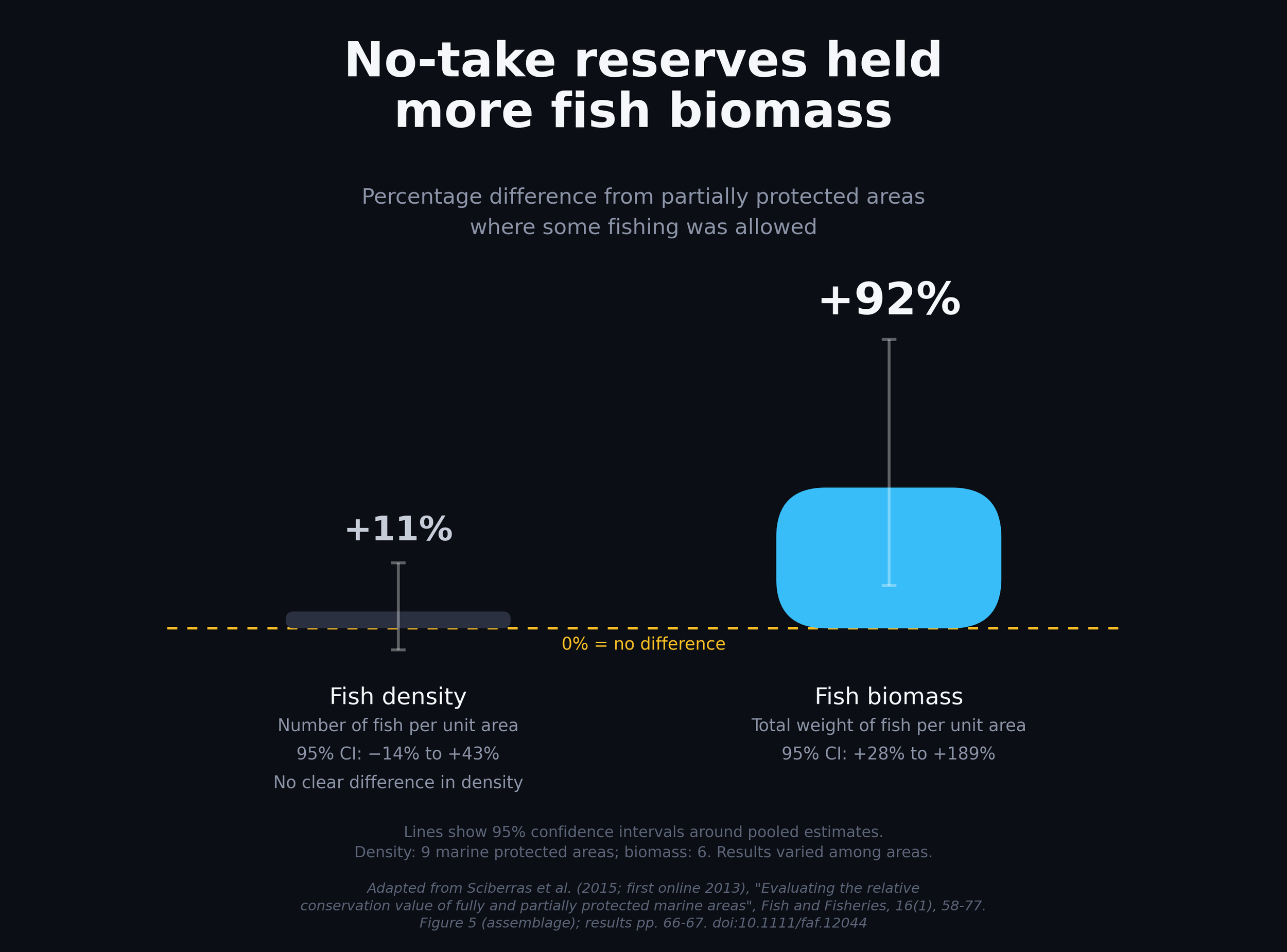
The researchers investigated whether partially protected marine areas improve fish populations and how they compare with fully protected no-take reserves. They systematically reviewed and combined data from 40 studies covering 63 marine protected areas worldwide. Fish density was 22% higher and biomass 51% higher in partially protected areas than in open waters, while no-take reserves supported 92% more fish biomass than partially protected areas.
3 Minute Evaluation
This paper is a systematic review and meta-analysis, meaning it combines evidence from many existing studies rather than collecting new field data. The researchers searched more than 4,800 scientific and government publications before applying strict selection criteria, ultimately analysing 40 studies. Larger, more reliable studies were given greater statistical weight, strengthening the overall conclusions.
The authors also tested whether factors such as habitat type, reserve age, size, distance from reserve boundaries and permitted fishing activities influenced the results. Studies with poor enforcement or unclear protection rules were excluded to make comparisons more consistent, although this also reduced the amount of available evidence.
Like any review, the findings are limited by the quality of the original studies. Most compared protected and unprotected sites only after protection had been established, making it difficult to know whether some differences already existed beforehand. There was also considerable variation in habitats, fish species and survey methods, and most of the evidence came from Europe and North America, so the results may not apply equally everywhere.
Evidence directly comparing no-take and partially protected areas was relatively limited. The widely cited finding that no-take reserves support 92% more fish biomass was based on just six comparisons, so while statistically significant, the exact figure should not be treated as universal.
Another important limitation is that "partial protection" covered a wide range of management approaches. Some areas only restricted destructive fishing methods, while others still allowed recreational, commercial or subsistence fishing. Enforcement levels and actual fishing pressure also varied considerably, which likely explains some of the differences in outcomes.
Most no-take reserves were located directly beside partially protected areas, and in almost every comparison the no-take reserve was actually smaller. Fish moving out of these reserves may therefore have boosted biomass in neighbouring partially protected areas, making the two appear more similar and potentially underestimating the full benefit of no-take protection. However, this spillover effect was not measured directly, so it remains a plausible explanation rather than a proven one.
The study focused on fish density and biomass. It did not assess species diversity, reproductive success, catches outside reserve boundaries, or broader social and economic outcomes. Likewise, while the authors suggest partial protection may be easier to implement politically, that question was not tested in the analysis.
The paper was published in the peer-reviewed journal Fish and Fisheries. The research team brought together expertise in marine ecology, fisheries science and evidence-based conservation. Lead author Marija Sciberras is now an associate professor who leads a marine evidence-synthesis research group. Funding came from academic and government scholarship sources and was fully disclosed.
The authors take a balanced position. Rather than arguing only for fully protected reserves, they conclude that partial protection provides meaningful conservation benefits, while consistently finding that well-enforced no-take reserves deliver the strongest ecological outcomes.
The study has been cited in the Australian Government's Commonwealth Marine Reserves Review and South Australia's marine protected-area reporting. Later research has reached similar conclusions, showing that fully protected reserves generally outperform partially protected areas.
Overall, this is a strong and credible synthesis of the available evidence. It shows that partial protection can improve fish populations, but well-enforced no-take reserves consistently produce the greatest increases in fish biomass.
Further reading
Related open-access review — Sciberras et al. (2013)
