
3 Second Summary
Assessments of expected MPA outcomes can inform and improve biodiversity conservation: Case studies using The MPA Guide
Sullivan-Stack, J., Ahmadia, G. N., Andradi-Brown, D. A., Barron, A., Brooks, C. M., Claudet, J., Horta e Costa, B., Estradivari, Field, L. C., Giakoumi, S., Gonçalves, E., Groulx, N., Harris, J., Jessen, S., Johnson, S. M., MacCarthy, J. M. C., Maricato, G., Morgan, L., Nalven, K. B., . . . Grorud-Colvert, K. (2024). Assessments of expected MPA outcomes can inform and improve biodiversity conservation: Case studies using The MPA Guide. Marine Policy, 170, Article 106364. https://doi.org/10.1016/j.marpol.2024.106364
3 Sentence Summary
This paper examined how assessing the quality of marine protected areas could improve conservation decisions beyond simply reporting their area. It drew on 13 assessments using The MPA Guide or a related classification system to examine protection and implementation across diverse countries and regions. The cases revealed gaps between reported coverage and the conditions expected to support conservation, but they did not test whether using these assessments caused biodiversity recovery or improved fishers’ livelihoods.
3 Minute Evaluation
This was a descriptive synthesis of 13 assessments: ten used The MPA Guide and three used an earlier regulations-based classification system. Evidence included journal articles, reports, a thesis and work still in preparation or review. The assessments covered different periods, rather than a common monitoring interval. Although they encompassed more than 90% of MPA area reported globally in February 2023, that broad area coverage was strongly influenced by very large MPAs. Overlap between global, regional and national assessments also means the cases are not independent replicates.
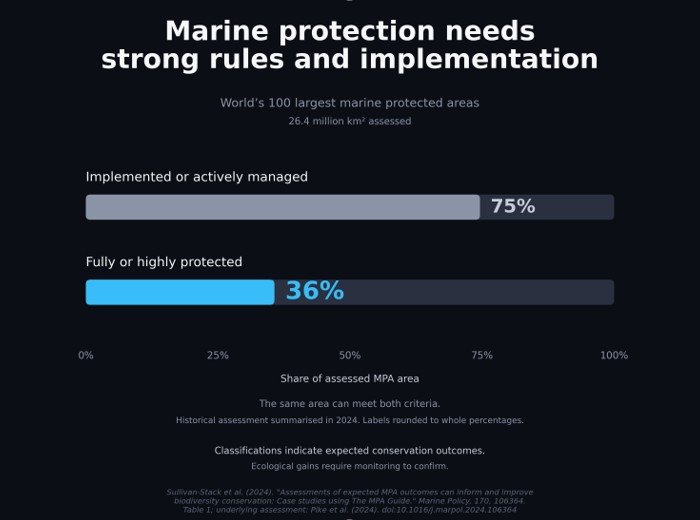
The framework separates Stage of Establishment, describing progress towards implementation and active management, from Level of Protection, describing the impact of activities within an MPA. It also identifies social and ecological Enabling Conditions needed for success. This distinction helps explain why counting designated area can exaggerate progress. In the included assessment of the 100 largest MPAs, about one-quarter of assessed area had not reached implementation.
Shared definitions and consultation with people who understand local conditions are strengths, particularly where jurisdictions use different names for similar protections. However, classifications depend on accurate information about activities actually occurring, not simply written regulations. The paper does not report a common test of agreement between independent assessors. Most included assessments also lacked a standardised, comprehensive evaluation of Enabling Conditions, including governance, adequate resources and equitable treatment. Consequently, a high protection category alone cannot establish effective or fair conservation.
The central limitation is the distinction between expected and observed outcomes. The case studies classify management and protection; they do not jointly test predictions against subsequent changes in biomass, biodiversity or human well-being. The paper recognises that monitoring and other evidence are needed to verify effectiveness. Its examples support the framework’s usefulness for identifying management gaps, while leaving its predictive accuracy unquantified here.
Some numerical reporting also needs reconciliation. Table 1 gives 5.3% of Canada’s assessed MPA area as Fully or Highly Protected, whereas the accompanying discussion gives 6.9%, without explaining the difference. That percentage should be checked against the underlying assessment before reuse. More broadly, the cases demonstrate why percentages need clear dates, geographic boundaries and denominators.
The paper was peer reviewed in Marine Policy, with authors from universities, research institutes and conservation organisations, including developers and users of the framework. Funding included public research agencies, the Kingfisher Foundation, Pew Charitable Trusts and National Geographic Pristine Seas; the supplied article contains no separate conflict-of-interest declaration. The reported use of assessments in Indonesian planning and discussions of French reserve expansion demonstrates practical influence, but does not itself demonstrate resulting ecological improvement.
For recreational fishers, the practical contribution is a clearer basis for discussing which activities are permitted, whether rules operate in practice and what management conditions support recovery. Local knowledge, Indigenous rights and measured ecological and social outcomes remain essential. The assessment does not establish that every partially protected area is ineffective or that a particular zoning change will improve catches.
The paper is convincing as a demonstration of how structured assessments can reveal gaps concealed by area totals. Its main limitation is the absence of direct validation of predicted ecological and social outcomes, compounded by incomplete assessment of enabling conditions. Give it substantial weight for assessment design and transparent reporting, but limited weight as evidence of realised biodiversity recovery or fishery benefits.
