
3 Second Summary
Marine protected area improves yield without disadvantaging fishers
Kerwath, S. E., Winker, H., Götz, A., & Attwood, C. G. (2013). Marine protected area improves yield without disadvantaging fishers. Nature Communications, 4(1), Article 2347. https://doi.org/10.1038/ncomms3347
3 Sentence Summary
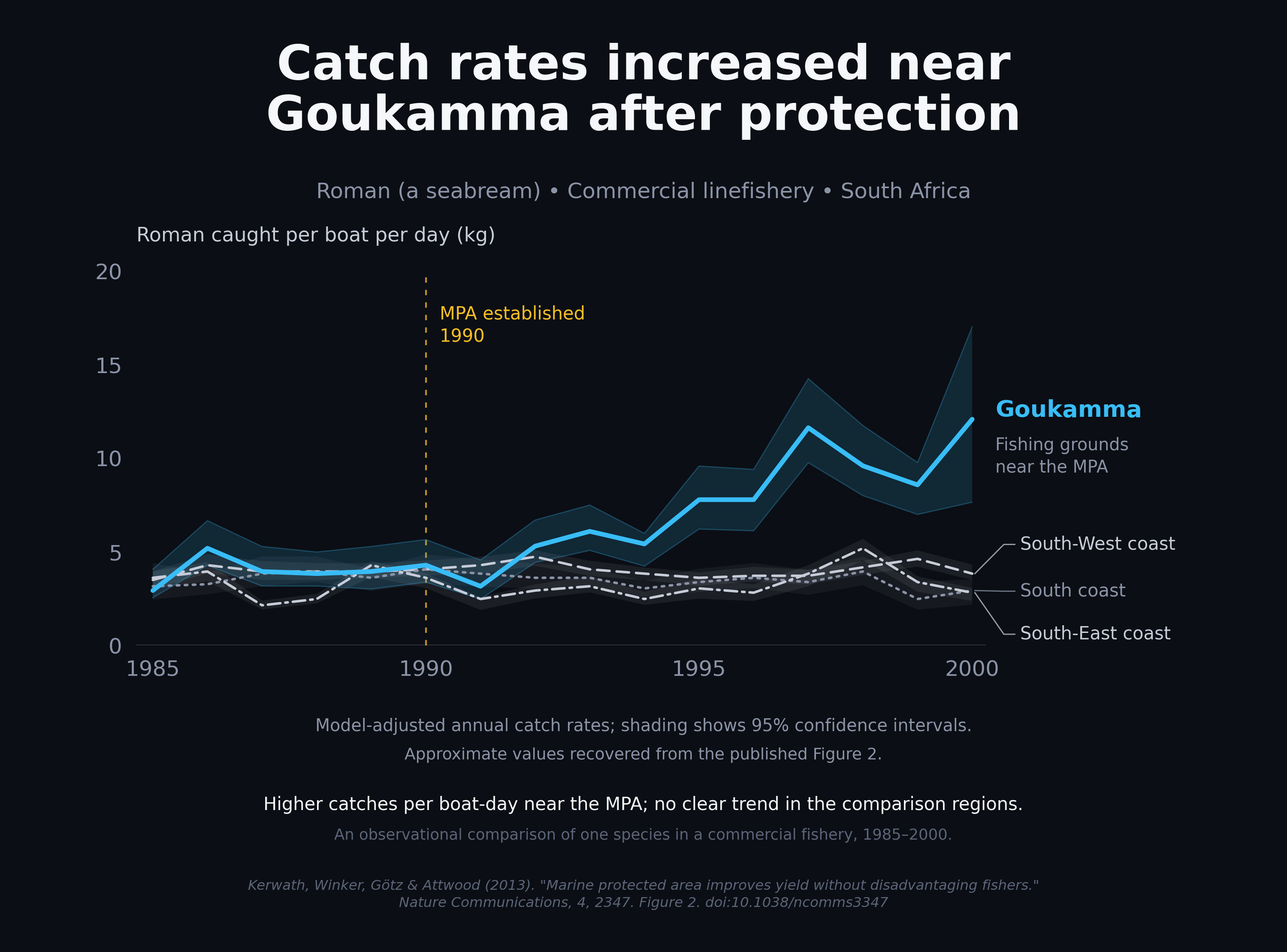
This study examined whether establishing South Africa’s Goukamma MPA benefited the adjacent commercial fishery for roman, a resident reef fish. Researchers analysed catch and effort records from 1985–2000, comparing standardised catch rates around the MPA with three other coastal regions before and after boat-based fishing was prohibited in 1990. Local catch rates approximately doubled over the following decade and total catches recovered above pre-closure levels, but the single-MPA design and incomplete economic measurements cannot establish that every fisher benefited or determine the contributions of adult movement and larval export.
3 Minute Evaluation
The study used a retrospective comparison of one 40 km² MPA with three regions spanning the rest of the species’ range. Several years of records before closure and a decade afterwards provide a stronger basis for attribution than a single comparison after protection. The analysis ended in 2000 to avoid confounding from subsequent national reductions in fishing effort. However, one non-randomly located MPA provides no replication of the intervention, and geographically different reference regions may experience different environmental changes.
Two-part statistical models accounted for zero catches and the amount caught on successful trips, adjusting for vessel, location, month and a measure of targeting. Annual catch-per-unit-effort estimates had 95% confidence intervals from 1,000 bootstrap samples. Supplementary Table S2 reports 1,581 retained local trip records from 15 of 79 vessels. Repeated trips improve precision without replicating the MPA intervention. Standardisation improves comparability but cannot eliminate unrecorded changes in fishing practices, reporting or fish availability.
Local catch rates rose after closure while the other regions showed no comparable upward trajectory. Total local roman catch, which had declined before establishment, subsequently increased and exceeded pre-closure levels by 1996. The combination strengthens the case for a fishery benefit. However, the paper fitted regional time series separately, without reporting a direct statistical estimate of the difference in changes between the MPA region and controls. Catch per boat-day also depends on catchability and is not a direct census of fish abundance.
The proposed sequence of adult spillover followed by larval export is biologically plausible for a depleted, resident reef fish. The continued increase after roughly five years matches the authors’ expectations for recruitment to the fishery. Nevertheless, these mechanisms were inferred from timing, previous studies and modelling; this analysis did not track exported adults or assign recruits to parents inside the MPA. The timing therefore cannot establish how much each mechanism contributed.
The claim about avoiding disadvantages is less secure than the catch-rate result. Effort maps used 5 × 5 nautical-mile cells, which can conceal shorter movements and added travel. Profits, fuel use, household income and the distribution of costs among fishers were not directly measured. No clear fleet-level displacement does not establish that nobody incurred costs. Reproducibility also needs clarification: the main article specifies a 30 km study boundary, whereas Supplementary Table S3 states 50 km.
Published in the peer-reviewed journal Nature Communications, the paper was written by South African fisheries researchers working in government, marine observation and the University of Cape Town. Funding came from government, the National Research Foundation, WWF South Africa and the university’s Marine Research Institute; no competing financial interests were declared.
For recreational fisheries, monitoring should include catch, effort, travel costs and how outcomes differ among fishers. Stock condition, fish movement and compliance determine how closely Goukamma resembles another location.
The study provides moderately convincing evidence that protection contributed to improved local fishing performance. Its main limitation is the single observational intervention, with economic impacts and spillover mechanisms incompletely established. Give it substantial weight as a fishery-benefit case for previously depleted resident reef fish, and limited weight for promises that other closures will increase catches without costs to individual fishers.
