
3 Second Summary
Decadal trends in marine reserves reveal differential rates of change in direct and indirect effects
Babcock, R. C., Shears, N. T., Alcala, A. C., Barrett, N. S., Edgar, G. J., Lafferty, K. D., McClanahan, T. R., & Russ, G. R. (2010). Decadal trends in marine reserves reveal differential rates of change in direct and indirect effects. Proceedings of the National Academy of Sciences, 107(43), 18256–18261. https://doi.org/10.1073/pnas.0908012107
3 Sentence Summary
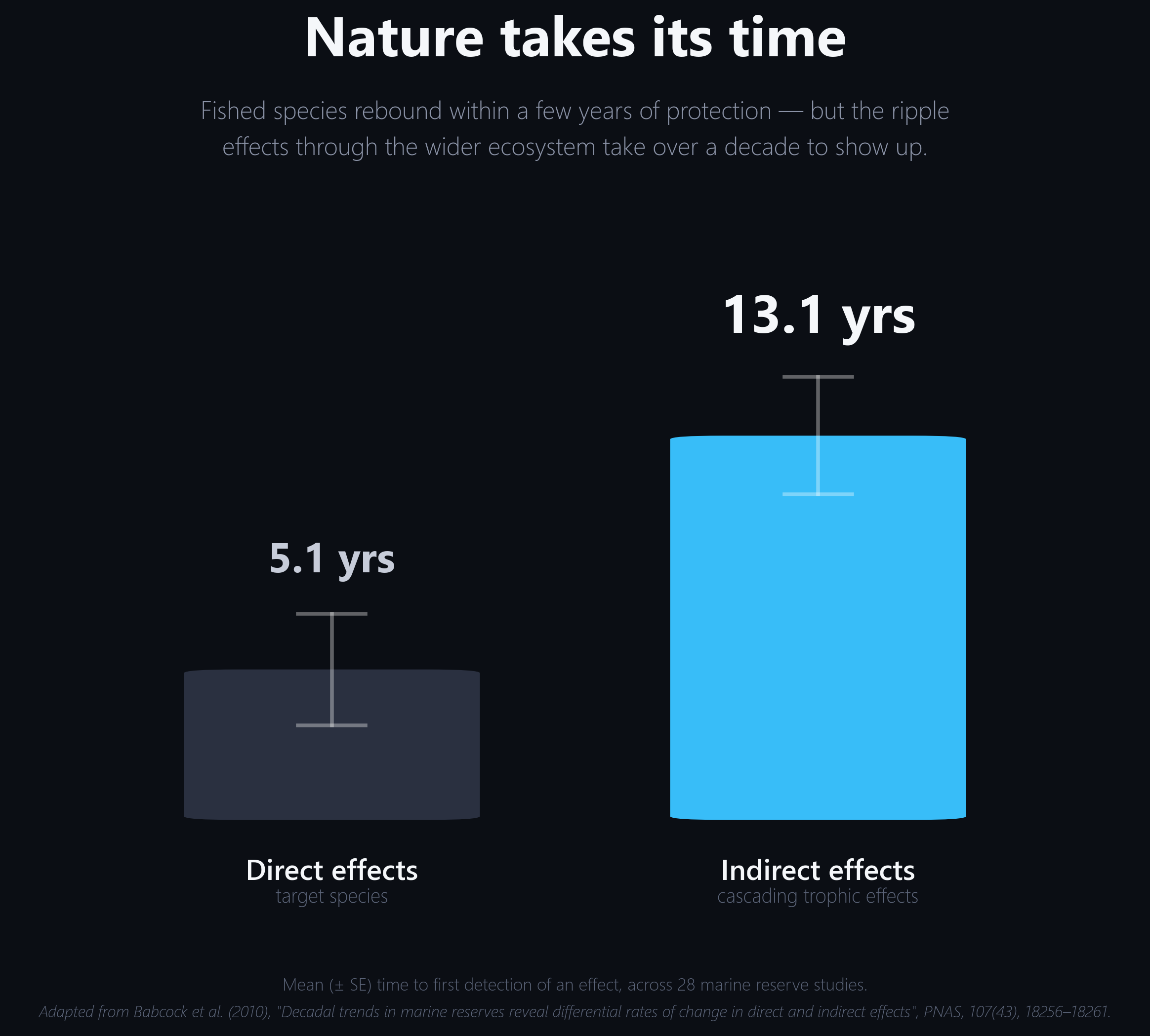
This study asked whether changes in harvested species appear sooner than changes mediated through food webs after fishing is excluded. The researchers reanalysed more than ten years of repeated surveys inside and outside reserves in six tropical and temperate case studies from New Zealand, Australia, California, the Philippines and Kenya. First detected changes averaged 5.1 ± 1.9 years for direct effects and 13.1 ± 2.0 years for indirect effects, expressed as means ± standard errors, but these are detection times in selected case studies rather than universal recovery deadlines.
3 Minute Evaluation
The study synthesised time series from five individual reserves and an aggregate of Kenyan reserves, all with high reported compliance. Eligible monitoring programmes extended for more than ten years, included at least ten sampling events, and began before or within five years of protection. The researchers examined density, biomass or cover of harvested species, their prey and habitat-forming organisms. Expressing each series relative to its initial value helped distinguish an increase inside a reserve from a growing difference caused by deterioration outside it.
Repeated observations revealed trajectories that a single survey would miss. Populations could increase, plateau or subsequently decline. At Leigh and Maria Island, predator recovery was followed by changes in urchins and algae consistent with trophic cascades. Some harvested species declined, including abalone at Maria Island, which the authors attributed to increased lobster predation. Protection therefore did not produce a uniform increase across all species that fishers might wish to catch.
The timing estimates require care. Standard errors describe uncertainty around the reported mean detection times, not the range of recovery times expected in a new reserve. Detection also depends on sampling frequency, baseline choice, measurement variability and statistical power. Some responses were identified using published tests and others graphically from confidence intervals. A reported timing comparison pairs a two-sided t statistic of 2.0 and 19 degrees of freedom with P < 0.001; those inputs instead imply approximately P = 0.060. This reporting inconsistency qualifies the precise significance claim without erasing the observed ecological trajectories.
The six case studies provide limited geographic replication, and several taxa shared the same reserve and food web. Recruitment pulses, disturbance and fishing near reserve boundaries could also influence their trajectories. Lower temporal variability in some protected populations suggests greater stability, but does not directly demonstrate faster recovery from disturbance or resistance to climate change.
The paper was peer reviewed in PNAS and written by researchers with direct experience of the monitoring programmes. The authors declared no conflicts of interest; the main article provides no consolidated funding statement for the contributing programmes. Later monitoring by Davis and colleagues similarly illustrates the importance of comparing protected and fished trajectories, although it does not validate Babcock’s exact timing estimates.
For fishers and managers, the study supports repeated monitoring of target species, predators, prey and habitat over substantial periods. Early non-detection should prompt examination of statistical power and implementation. It does not establish that every target species will recover, that a trophic cascade is inevitable, or that catches outside reserves will improve.
The time series provide convincing examples of delayed and variable ecological responses, with moderate support for the general pattern that indirect effects emerge later. The main limitation is the small, heterogeneous case-study set, compounded by inconsistent detection methods and a reported statistical discrepancy. Give the paper substantial weight when designing long-term monitoring, but limited weight as a timetable for a particular sanctuary or evidence of universal resilience.
