
3 Second Summary
Two decades of monitoring within a temperate marine park shows no-take zone and climate-change impacts on fish, invertebrates and coral cover
Davis, T. R., Gladstone, W., & Harasti, D. (2026). Two decades of monitoring within a temperate marine park shows no-take zone and climate-change impacts on fish, invertebrates and coral cover. Marine and Freshwater Research, 77, Article MF26004. https://doi.org/10.1071/MF26004
3 Sentence Summary
This study asked whether no-take zoning in Port Stephens–Great Lakes Marine Park conserved reef communities and altered their responses to tropicalisation. Researchers surveyed three sanctuary sites and three fished habitat-protection sites in November 2007, 2012, 2017 and 2024, measuring fish and invertebrates on replicated transects and coral cover from 2012 onwards. Targeted-fish biomass trajectories differed between zones and community thermal affinity increased, but no climate-buffering effect of zoning was detected and the small observational site network limits causal claims.
3 Minute Evaluation
The study followed six shallow rocky-reef sites over 17 years, with four transects per site during each survey. Zoning was not randomly assigned, and the initial survey followed its introduction. Trained divers used standard survey areas, consistent seasonal timing and procedures to reduce double-counting and disturbance. Fish lengths were converted to biomass using species-specific relationships. PERMANOVA incorporated year, zone and site nested within zone, and dispersion was checked. Coral photographs were standardised by area, although photographic sampling was substantially greater in 2024.
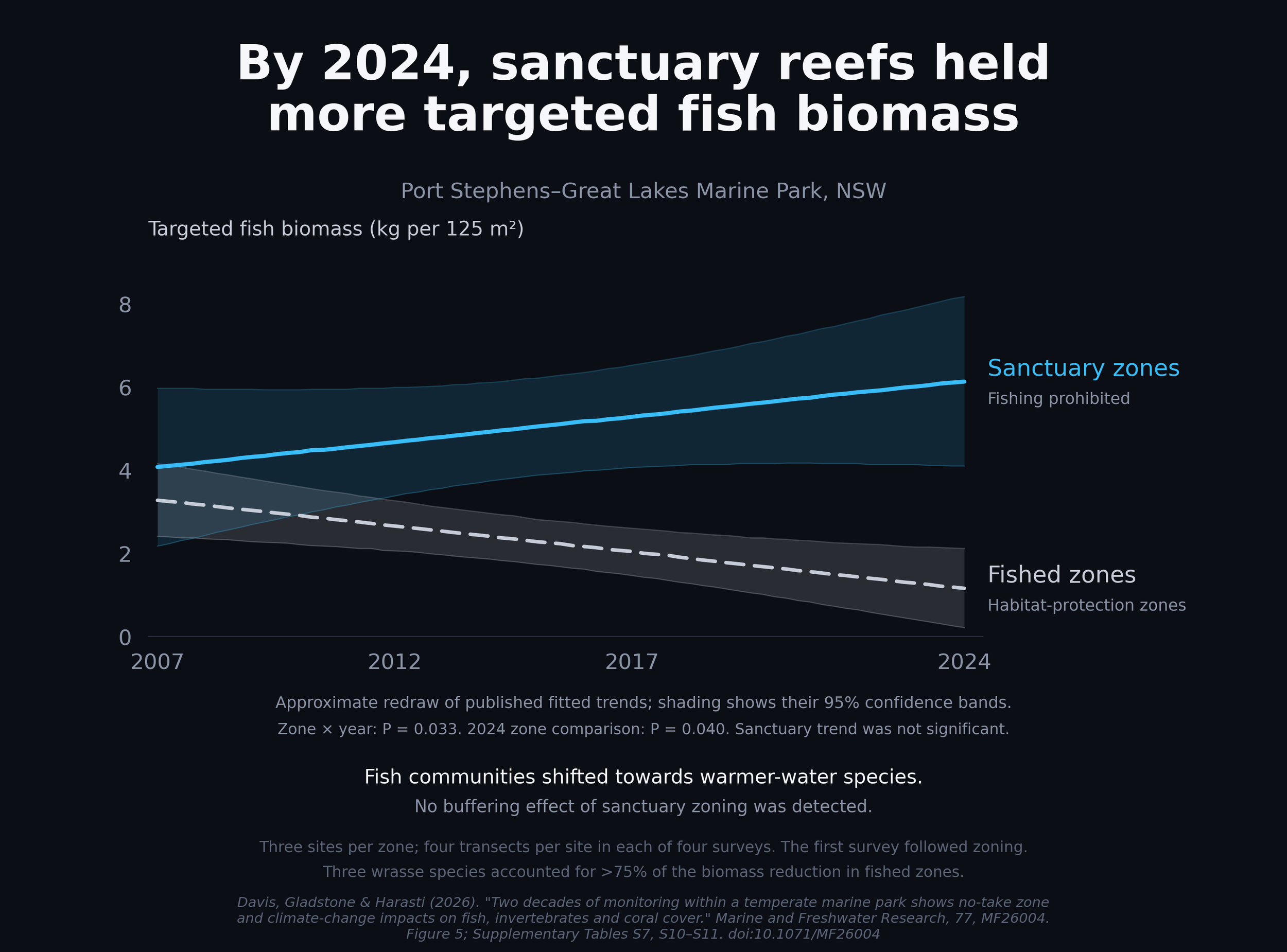
Targeted-fish biomass showed a zone-by-year interaction (P = 0.033), supporting different trajectories between zones. Sanctuary biomass exceeded fished-zone biomass in 2024 (P = 0.040). The sanctuary trend itself was not significant, and high variability limited the ability to detect change. This distinction matters: a significant decline in one group and a non-significant trend in another would not, by themselves, demonstrate different trajectories. Here, the interaction supplies additional evidence. More than 75% of the biomass reduction in fished zones came from three wrasses, so the result does not describe a uniform response among fishing targets.
Fish community thermal affinity increased by approximately 0.29°C. This community thermal index measures the thermal niches of the species present; it is not a direct measurement of warming at the survey sites. Its increase is consistent with tropicalisation through changes in species composition. Long-spined urchins declined and coral cover increased, but these changes had no detected zoning interaction. Non-significance does not establish identical responses or exclude every possible buffering effect. The authors also considered flooding a plausible explanation for urchin declines.
Three sites per zone and four widely spaced surveys constrain replication and the resolution of disturbances and recruitment. Habitat, exposure, fishing pressure and compliance could influence outcomes, while warming was not isolated from changes in currents, recruitment or habitat. Both comparison groups were inside the marine park, so the study cannot establish the park’s total biodiversity benefit against an unprotected alternative. An absence of progressive species-richness decline is also compatible with changes in species identity, abundance and ecological function.
The paper was peer reviewed in Marine and Freshwater Research, with authors from NSW fisheries research and UTS. It was funded by the NSW Marine Estate Management Strategy, and the authors declared no conflicts of interest. Earlier reserve time series synthesised by Babcock and colleagues provide context for variable trajectories, but do not independently validate this park’s zoning or climate effects.
For fishers, a potential protection benefit can involve retaining biomass while nearby fished sites decline. Monitoring should therefore consider size and biomass alongside abundance, habitat and fishing pressure. This study does not establish improved catches outside sanctuaries or recovery of every target species.
This study adds long-term evidence from Port Stephens–Great Lakes Marine Park, documenting changes consistent with tropicalisation and suggesting that no-take zoning helped retain targeted-fish biomass. Its findings are most directly applicable to the reefs and species surveyed. No buffering of the measured tropicalisation responses was detected. Further monitoring across a wider range of sites and ecological responses would help clarify the broader role of zoning under climate change.
Further reading
