
3 Second Summary
Capacity shortfalls hinder the performance of marine protected areas globally
Gill, D. A., Mascia, M. B., Ahmadia, G. N., Glew, L., Lester, S. E., Barnes, M., Craigie, I., Darling, E. S., Free, C. M., Geldmann, J., Holst, S., Jensen, O. P., White, A. T., Basurto, X., Coad, L., Gates, R. D., Guannel, G., Mumby, P. J., Thomas, H., . . . Fox, H. E. (2017). Capacity shortfalls hinder the performance of marine protected areas globally. Nature, 543(7647), 665–669. https://doi.org/10.1038/nature21708
3 Sentence Summary
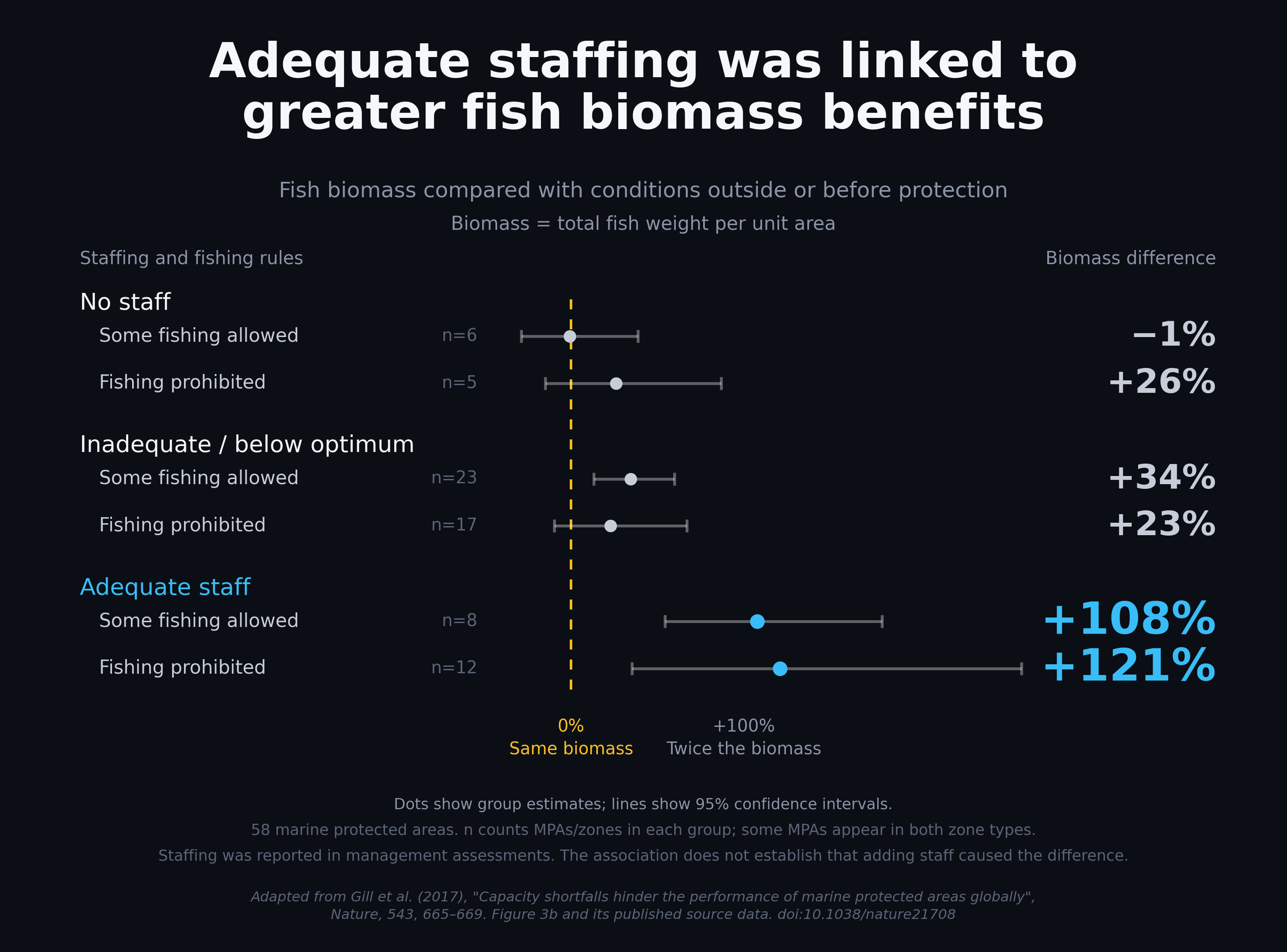
This study asked whether management capacity and practices help explain why marine protected areas differ in their ecological performance. The researchers combined global management assessments from 2000–2015 and fish-survey datasets spanning 1997–2015 with earlier published comparisons, linking management and ecological outcomes for 62 marine protected areas. Adequately staffed areas generally showed larger positive fish biomass contrasts with reference areas, but the observational design cannot establish how much benefit would follow from adding staff to a particular park.
3 Minute Evaluation
The study combined information on management and ecological outcomes across marine protected areas (MPAs). Management data covered 433 MPAs, ecological data covered 218, and 62 had both. Most ecological observations came from underwater visual surveys of coastal coral or rocky reefs, with fish lengths and counts converted to biomass. For 178 MPAs, protected observations were statistically matched to comparable unprotected or pre-establishment observations; another 40 MPAs came from earlier syntheses.
Across the ecological dataset, the mean log-response ratio corresponded to approximately 1.6 times the reference biomass, although outcomes varied considerably among MPAs. Seventy-one per cent had positive estimates, which does not mean that 71% had individually significant effects. Staffing was the strongest management predictor, while budget capacity was also associated with performance. The widely quoted 2.9-fold staffing contrast refers to the study’s measure of ecological effect, based on log-response ratios. It should not be interpreted as a demonstrated 2.9-fold increase in raw fish biomass caused by hiring staff.
Statistical matching improved comparisons for measured environmental and social conditions, but could not remove differences in unmeasured habitat quality, fishing pressure or governance. Staffing and budgets were correlated with other management practices, and management assessments did not always coincide with fish surveys. Stakeholder ratings were also imperfect measures of actual capacity. Only 62 MPAs contributed to the management–outcome analysis, with budget information available for 43, limiting how confidently management factors could be ranked. Non-significant results for participation or monitoring do not establish that these processes are unimportant.
The paper was peer reviewed in Nature and involved researchers with ecological and governance expertise. It received US National Science Foundation support through SESYNC, alongside other research support and fellowships; the authors declared no competing financial interests. A later analysis by Gill and colleagues also linked performance to staffing and context, but reused earlier datasets and therefore does not provide an independent replication.
For recreational fishers, the practical implication is that sanctuary proposals should be assessed alongside their staffing, enforcement, monitoring and funding arrangements. The study supports attention to implementation, but supplies no universal staffing ratio or budget formula. It also does not measure recreational catch rates, spillover, displaced fishing effort or the distribution of social costs and benefits.
The study provides convincing evidence of widespread reported capacity shortfalls and moderate evidence that capacity predicts ecological performance. Its main limitation is the small observational management–outcome sample, with correlated management factors and imperfect temporal alignment. It deserves substantial weight in identifying implementation priorities, but limited weight for predicting the benefit of a particular staffing or budget increase.
Further reading
