
3 Second Summary
Marine reserves: Size and age do matter
Claudet, J., Osenberg, C. W., Benedetti-Cecchi, L., Domenici, P., García-Charton, J.-A., Pérez-Ruzafa, Á., Badalamenti, F., Bayle-Sempere, J., Brito, A., Bulleri, F., Culioli, J.-M., Dimech, M., Falcón, J. M., Guala, I., Milazzo, M., Sánchez-Meca, J., Somerfield, P. J., Stobart, B., Vandeperre, F., . . . Planes, S. (2008). Marine reserves: Size and age do matter. Ecology Letters, 11(5), 481–489. https://doi.org/10.1111/j.1461-0248.2008.01166.x
3 Sentence Summary
The researchers investigated whether the size, age and design of marine reserves influenced their ecological performance. They combined results from 40 studies across 12 southern European marine reserves, comparing fish populations inside no-take zones with nearby fished areas. Medium-to-large harvested fish were consistently more abundant inside reserves, with the strongest responses occurring in reserves that were both larger and older.
3 Minute Evaluation
This paper is a regional meta-analysis, meaning it combines findings from many existing studies rather than collecting new field data. It analysed 40 comparisons from 12 marine reserves, spanning up to 30 years of protection. Most studies used underwater visual surveys, while one used experimental fishing, allowing researchers to compare fish populations inside no-take zones with nearby unprotected reefs.
The methods were clearly described. Data were supplied by 14 research teams, fish were grouped according to whether they were commercially harvested and by body size, and the analysis examined how reserve age, no-take area, buffer-zone area and the distance to the nearest reserve influenced results. Studies were weighted by their statistical precision, giving more influence to stronger datasets.
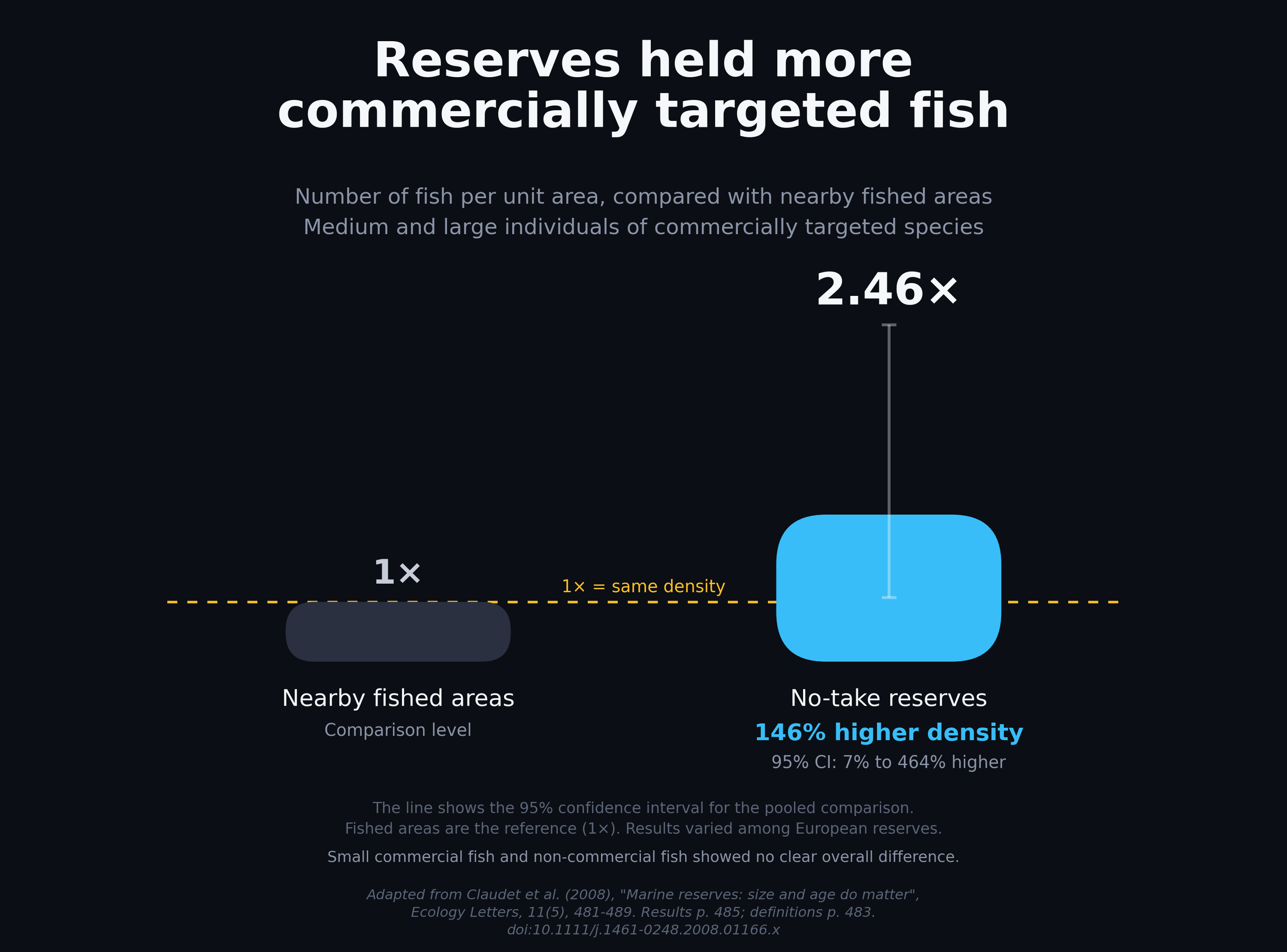
Overall, the analysis found that medium-to-large harvested fish were more abundant inside no-take zones, and that these differences were greatest in reserves that had been protected for longer and covered larger areas. Smaller harvested fish and non-harvested species showed weaker or more variable responses, which should be interpreted as no consistent overall effect rather than evidence that protection had no benefit.
Like most marine reserve studies, this was observational. The researchers could not randomly assign reserve size or age, and none of the reserves had a fully replicated before-after-control-impact design. Differences in habitat quality, reserve placement or historical fishing pressure may therefore have contributed to the results.
The study also examined only 12 reserves with complete design information. Important factors such as enforcement quality, habitat condition and fishing effort were not included in the analysis, even though they may influence ecological outcomes.
Likewise, the suggested explanation that larger buffer zones concentrate fishing around reserve boundaries was not directly tested, and the measure of reserve connectivity did not account for ocean currents, larval dispersal or habitat continuity.
The paper was published in the peer-reviewed journal Ecology Letters by a large team of marine scientists with expertise in reserve ecology and fisheries. Funding from the European Commission's EMPAFISH program was disclosed, although the paper did not include a formal conflict-of-interest statement.
Subsequent research has broadly supported the importance of reserve age and design. A global analysis by Edgar et al. (2014) found that reserve size and age were among several characteristics linked to stronger ecological outcomes.
However, later Mediterranean research suggested that enforcement was an even stronger predictor of fish biomass, with small, older, well-enforced reserves also producing substantial benefits (Giakoumi et al. (2017)).
Because the analysis focused on temperate European reef fishes, the findings are most relevant to relatively sedentary species. Highly mobile pelagic fishes were not included, so the results should not be applied broadly to all fisheries.
Overall, this study provides credible evidence that reserve age and no-take area are important ingredients of effective marine reserves. It does not suggest that small reserves cannot work, nor does it identify a universal minimum reserve size.
Instead, it supports the idea that protecting enough habitat and protecting it for long enough improves the likelihood of achieving strong ecological outcomes, while recognising that factors such as enforcement and habitat quality remain equally important.
Further reading
