
3 Second Summary
Global conservation outcomes depend on marine protected areas with five key features
Edgar, G. J., Stuart-Smith, R. D., Willis, T. J., Kininmonth, S., Baker, S. C., Banks, S., Barrett, N. S., Becerro, M. A., Bernard, A. T. F., Berkhout, J., Buxton, C. D., Campbell, S. J., Cooper, A. T., Davey, M., Edgar, S. C., Försterra, G., Galván, D. E., Irigoyen, A. J., Kushner, D. J., . . . Thomson, R. J. (2014). Global conservation outcomes depend on marine protected areas with five key features. Nature, 506, 216–220. https://doi.org/10.1038/nature13022
3 Sentence Summary
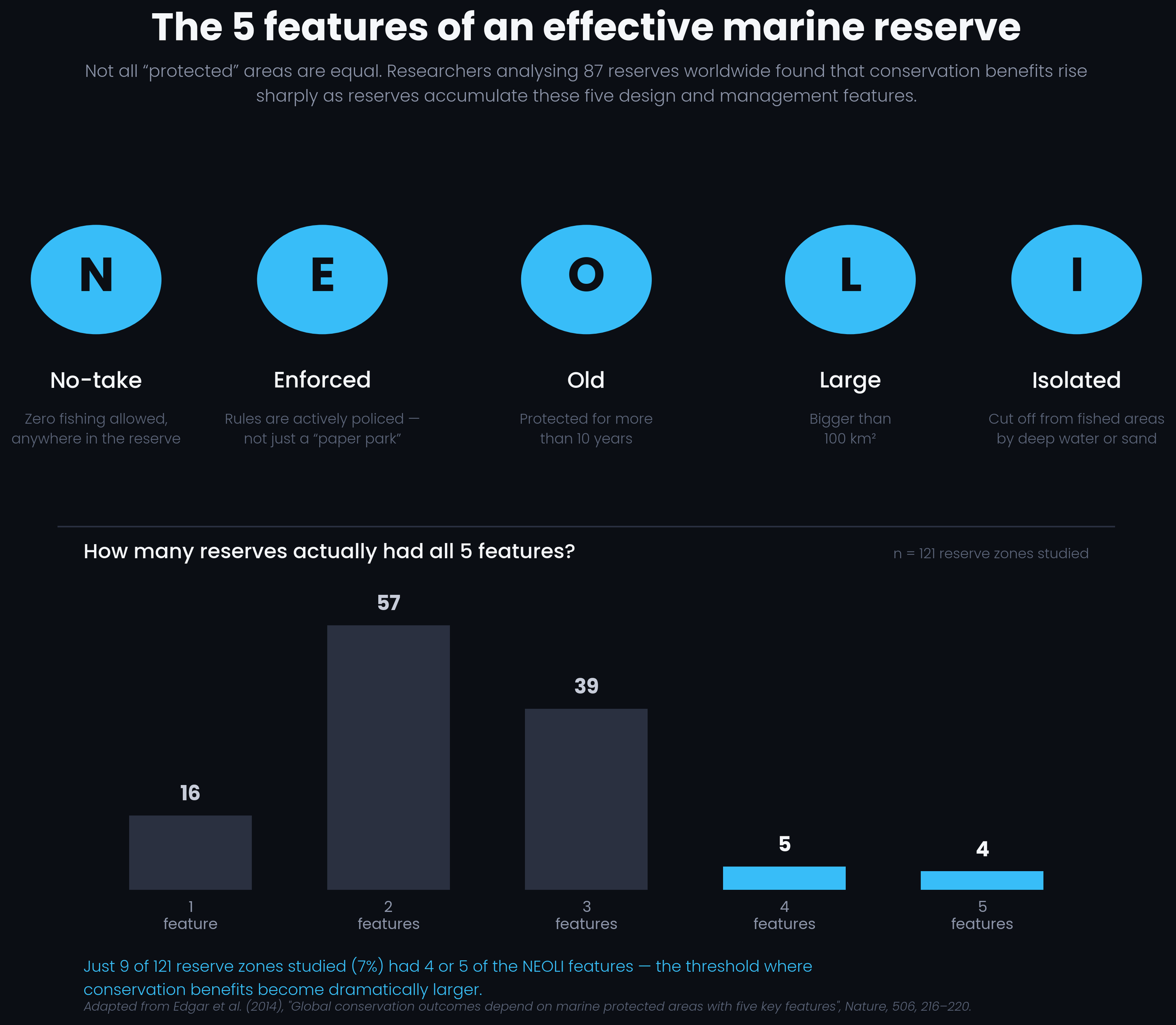
This global study investigated why some marine protected areas perform better than others. Researchers surveyed reef fish communities across 87 protected areas in 40 countries and assessed five characteristics: no-take protection, effective enforcement, age, size and ecological isolation. Marine protected areas with four or five of these features supported much higher fish biomass and more large fish species, while those with only one or two features showed no clear improvement over expected conditions at fished sites.
3 Minute Evaluation
This was a global observational study using Reef Life Survey data from 1,986 coral and rocky reef sites. Researchers recorded fish abundance, size, biomass and species richness using standardised underwater surveys. Rather than comparing conditions before and after protection, they compared protected areas with statistical predictions for equivalent fished reefs.
One of the study's greatest strengths is its scale. It included 87 marine protected areas across 40 countries, with all surveys conducted using the same methods. Divers received standardised training, volunteer data had previously been validated against professional surveys, and the statistical models accounted for 14 environmental and socioeconomic factors. Confidence intervals and cross-validation were also used to assess uncertainty and model accuracy.
The researchers identified five features associated with the strongest ecological outcomes: no-take protection, effective enforcement, older age, larger size and ecological isolation. Marine protected areas possessing four or five of these characteristics consistently supported more biomass and more large fish species than areas with fewer features.
There are, however, important limitations. Nearly half of the protected areas were located in Australia or New Zealand, and only four reserves possessed all five characteristics. This means the largest reported effects are based on a relatively small group of sites. The five features were also not independent. Older reserves, for example, may also have better enforcement or be located in more favourable habitats.
Enforcement was assessed using local knowledge and researcher observations rather than standardised compliance records, introducing some subjectivity. In addition, all four reserves with all five features were isolated oceanic islands, so geography and naturally high productivity may have contributed to their exceptional performance.
The study focused solely on reef fish communities. It did not measure recreational or commercial catches, spillover to surrounding fisheries, tourism, education, cultural values or economic outcomes.
The paper was published in the peer-reviewed journal Nature by an international team of marine ecologists. It was supported by Australian Government research programs, the Australian Research Council and other research organisations, and the authors declared no competing financial interests.
Subsequent research has broadly reinforced the importance of strong protection, enforcement and long-term management, while suggesting that reserve size is more context-dependent than originally proposed. Small, well-enforced reserves can still produce substantial ecological benefits, particularly for less-mobile species (Giakoumi et al. (2017)). The broader principle that marine reserve outcomes depend on both protection level and effective management has since been incorporated into the MPA Guide.
The findings are highly relevant to NSW marine management, but the thresholds used in the study, such as defining "large" reserves as greater than 100 km², were analytical categories rather than universal design standards.
Smaller sanctuary zones may still protect local fish populations and deliver important recreational, educational and community benefits, although these outcomes were outside the scope of this research.
Overall, this is one of the most influential global studies of marine protected areas. Its central message is that simply declaring a protected area is not enough. Successful reserves tend to combine multiple complementary features, particularly effective protection, enforcement and sufficient time for ecosystems to recover.
The exact size of the reported effects should be interpreted cautiously, but the overall management principles are strongly supported by subsequent research.
Further reading
