
3 Second Summary
Biological effects within no-take marine reserves: A global synthesis
Lester, S. E., Halpern, B. S., Grorud-Colvert, K., Lubchenco, J., Ruttenberg, B. I., Gaines, S. D., Airamé, S., & Warner, R. R. (2009). Biological effects within no-take marine reserves: A global synthesis. Marine Ecology Progress Series, 384, 33–46. https://doi.org/10.3354/meps08029
3 Sentence Summary
This synthesis examined whether no-take marine reserves were associated with higher biomass, density, organism size and species richness, and whether responses differed between temperate and tropical settings. Researchers combined 149 peer-reviewed publications from 1977–2006 covering 124 reserves in 29 countries, predominantly using comparisons between sites inside and outside reserves. All four measures were higher on average, with the largest difference in biomass, but substantial variation and limited observations before protection constrain causal attribution and predictions for individual reserves.
3 Minute Evaluation
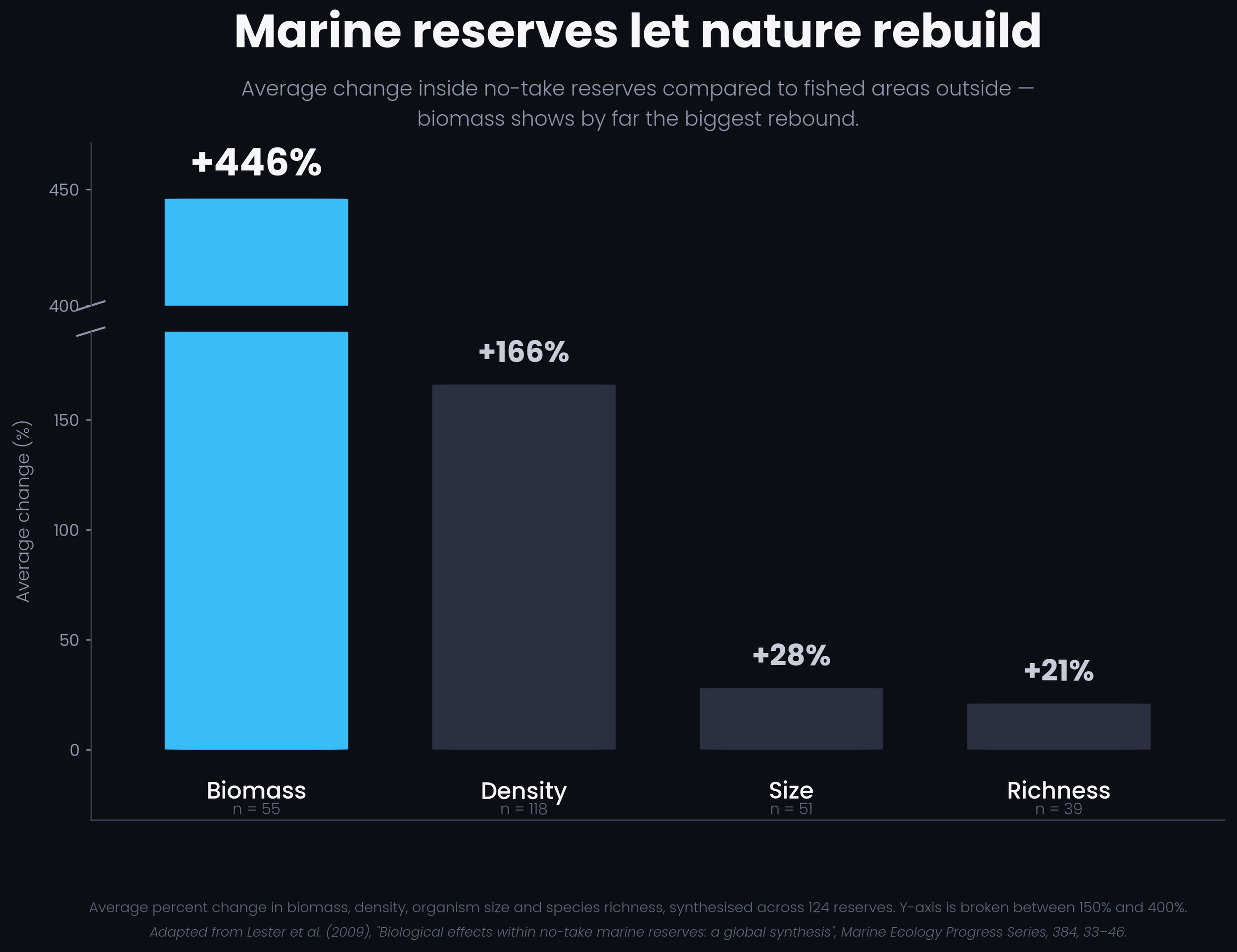
The evidence came predominantly from nearshore rocky and coral reefs, with different species, survey methods and durations of protection. Sample sizes differed by outcome: 55 reserves contributed biomass data, 118 density, 51 organism size and 39 species richness. Averaging multiple studies of the same reserve reduced the influence of frequently studied locations. However, the analysis did not weight estimates by their sampling precision, and combining studies cannot remove differences in measurement quality or habitat.
Across reserve response ratios, the reported mean biomass difference was 446%, equivalent to 5.46 times the comparison value, while the median difference was 194%, or 2.94 times. Corresponding mean differences were 166% for density, 28% for organism size and 21% for species richness. Tests on log-transformed response ratios supported positive average differences for all four measures. The much higher mean than median biomass response shows the influence of exceptionally large contrasts. These figures combine spatial and temporal comparisons; they are not uniform increases observed after protection or reliable forecasts for a new sanctuary.
The authors used 23 studies with observations inside and outside reserves before and after establishment to examine alternative explanations. They found no statistically significant initial biological advantage inside future reserves, and no general decline outside following protection. These checks strengthen the interpretation that protection contributed to the contrasts, but outcome-specific samples were small, including only six studies for biomass. Non-significance cannot exclude habitat advantages or displaced fishing pressure, and the limited subset cannot resolve those possibilities across all 124 reserves.
Positive responses occurred in both temperate and tropical reserves, supporting relevance to temperate reef conservation. However, non-significant regional differences do not establish equivalent effects. Mostly small reserves and limited coverage of highly mobile species also weaken conclusions about reserve size. Greater biomass per unit area in a small reserve does not establish the same total conservation benefit as protection across a larger area.
Potential publication bias from restricting the evidence to published studies was not formally assessed. The authors acknowledged that studied reserves might be better enforced than reserves generally. Inside–outside differences also need to be read alongside time series: a growing contrast can arise through recovery inside, decline outside, or both.
The paper was peer reviewed in Marine Ecology Progress Series and involved university and NOAA researchers. Funding included the Packard and Moore foundations and NOAA scholarship support; the supplied article contains no separate conflict-of-interest declaration. For fishers, it supports the potential for sanctuaries to retain more biomass and larger organisms. It did not measure improved fishing catches, profits or net population gains across protected and fished waters.
The evidence is convincing that the studied reserves generally held greater biomass and larger organisms than their comparison conditions. Its main limitation is reliance on observational inside–outside contrasts that incompletely separate protection from habitat, fishing pressure and selection effects. Give it substantial weight for biological benefits within well-enforced reef reserves, but limited weight for exact local percentage gains or benefits to fisheries outside their boundaries.
