
3 Second Summary
Larval export from marine reserves and the recruitment benefit for fish and fisheries
Harrison, H. B., Williamson, D. H., Evans, R. D., Almany, G. R., Thorrold, S. R., Russ, G. R., Feldheim, K. A., van Herwerden, L., Planes, S., Srinivasan, M., Berumen, M. L., & Jones, G. P. (2012). Larval export from marine reserves and the recruitment benefit for fish and fisheries. Current Biology, 22(11), 1023–1028. https://doi.org/10.1016/j.cub.2012.04.008
3 Sentence Summary
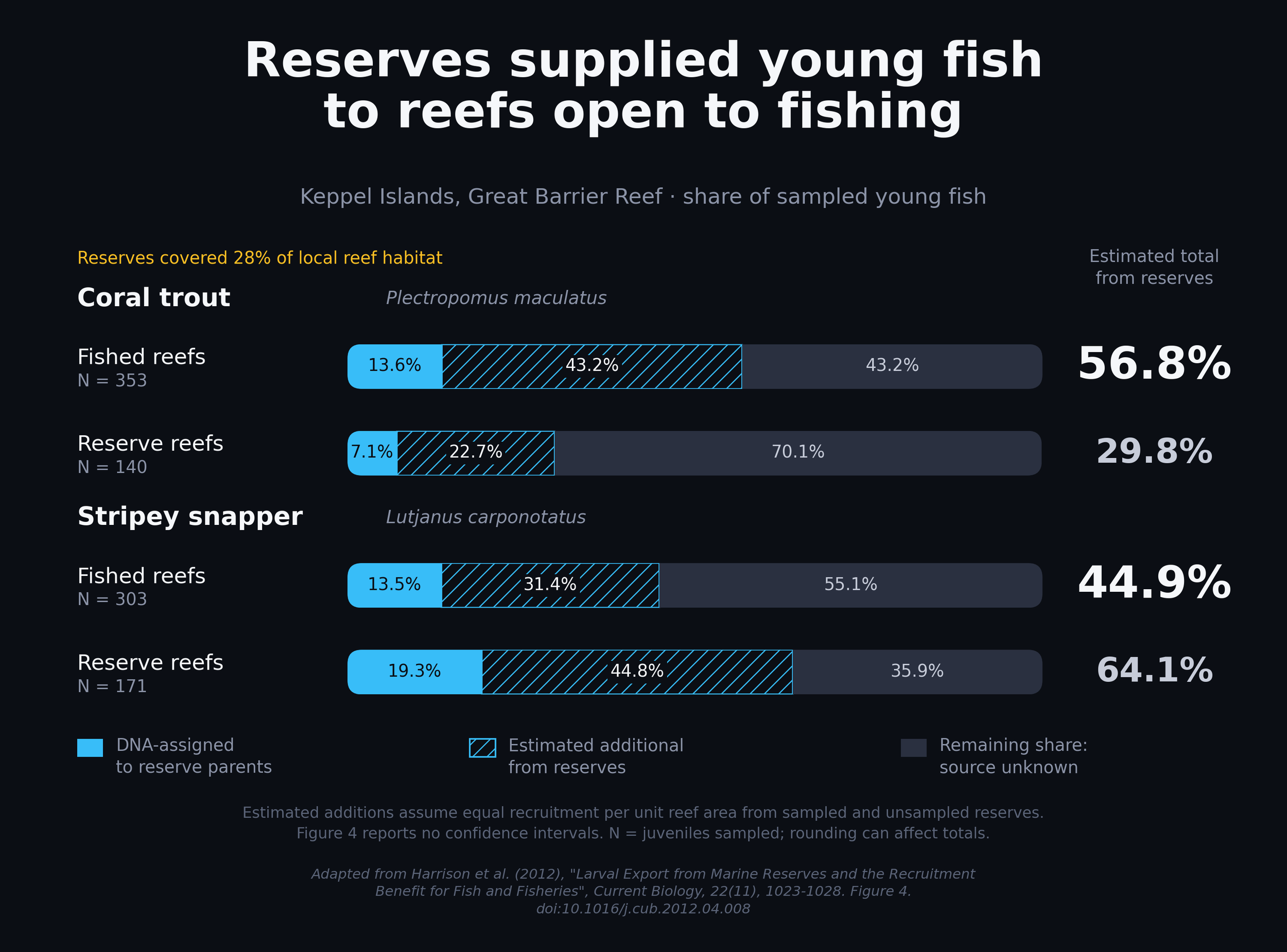
This study tested whether no-take reserves in Queensland’s Keppel Islands supplied juvenile coral trout and stripey snapper to protected reefs and reefs open to fishing. Researchers genotyped 1,620 adults from three reserves and 967 juveniles from 19 locations, using DNA parentage analysis to reconstruct successful dispersal over distances of up to 28 kilometres. Juveniles produced by reserve parents recruited both within the reserve network and onto fished reefs, while a scaling analysis estimated that reserves covering 28% of local reef habitat supplied approximately half of regional recruitment.
3 Minute Evaluation
This was an observational field study across approximately 1,000 km² of the Keppel Islands. Adults of two commercially and recreationally targeted species were sampled from three no-take reserves; juveniles were subsequently collected from 19 protected and fished locations over 15 months. Parentage was identified using 11 or 13 microsatellite markers and a standardised maximum-likelihood procedure.
The sample was substantial, and the use of multiple genetic markers produced unique individual profiles, reducing ambiguity in parentage assignments. Researchers assigned 58 juvenile coral trout and 74 stripey snapper to sampled reserve adults; respectively, 83% and 55% of these juveniles were found on reefs open to fishing. This provides strong direct evidence of larval export, although the number of assigned juveniles was considerably smaller than the total sample.
The estimate that reserves supplied approximately half of regional recruitment was not directly observed. It was calculated by adjusting for unsampled adults and extrapolating from three sampled reserves to three unsampled reserves. Unassigned juveniles should not be interpreted as evidence of non-reserve origin because many potential parents were not sampled.
The study covered one island group, two reef-fish species and a limited recruitment period. Reserve placement was not experimental, and habitat, currents, adult abundance and reproductive output could all influence recruitment patterns. The regional estimate also assumed that unsampled reserves produced recruits at the same rate per unit of reef as sampled reserves.
The study measured successful settlement by juveniles. It did not follow their later survival, contribution to adult populations or capture by fishers. It therefore demonstrates a recruitment pathway without establishing increased catches, economic returns or what would have occurred without the reserves.
The research was peer reviewed and published in the relevant journal Current Biology. The multidisciplinary author group had expertise in coral-reef ecology, fisheries, genetics and larval dispersal. Funding was disclosed from Australian government research programs, the Australian Research Council and the Packard Foundation.
Later work adds context. Harrison and colleagues (2020) examined larval supply across several reserve populations and recruitment cohorts. Bode and colleagues (2025) combined data and modelling to estimate Great Barrier Reef reserves’ contributions to recruitment and fishery yield. These studies support the relevance of larval export, but the later yield estimates are model-based rather than direct tracking of the 2012 juveniles into catches.
The study strongly supports the principle that connected no-take reserves can supply recruits beyond their boundaries. However, the reported distances and contribution percentages should not be transferred directly to NSW because species behaviour, habitats, currents, reserve design and fishing pressure differ.
For recreational fishers, the practical implication is that reserve networks can contribute juveniles to reefs where fishing occurs. The authors also emphasise that reserves should work alongside size limits, catch limits and seasonal protections.
The study provides convincing direct evidence that offspring produced by adults inside reserves can recruit to both protected and fished reefs. Its principal limitation is that the estimate of approximately half of regional recruitment depends on extrapolation from incompletely sampled adult populations and reserves. It should receive high weight as evidence that larval export occurs, but moderate weight for its estimated magnitude and the fishery benefits expected elsewhere.
Further reading
Harrison et al. (2020) — A connectivity portfolio effect stabilizes marine reserve performance
Bode et al. (2025) — Great Barrier Reef reserve contributions
